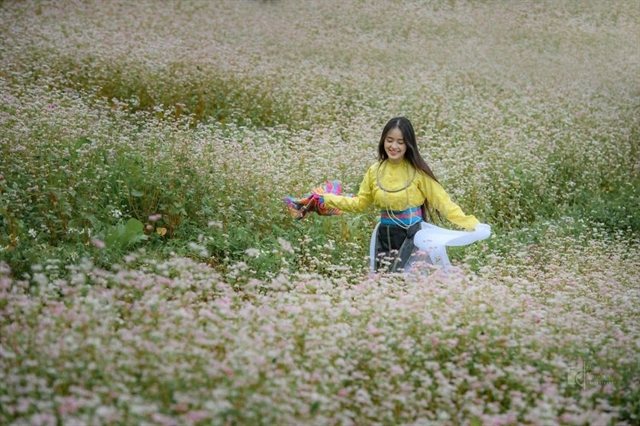
Every autumn, the grey limestone of the Đồng Văn Karst Plateau in Vietnam's northern Tuyên Quang province turns pink and white, as buckwheat flowers bloom across the highlands. What began as a hardy staple crop for local communities has become the region's signature tourist attraction — and this year, local officials are trying to make it do more than look pretty.
The 12th Buckwheat Flower Festival kicks off later this month, and the strategy behind it has shifted. Rather than packing the spectacle into a short bloom window, authorities are staggering the sowing of around 400 hectares of buckwheat from October through December, stretching the season to roughly three months. By early October, more than 242 hectares had already been planted across 12 communes.
The numbers explain the ambition. In the first nine months of 2026, Tuyên Quang welcomed more than 3.24 million visitors, including 567,443 international arrivals, generating an estimated VNĐ8.98 trillion (about US$346 million) in tourism revenue. The province has 1,519 accommodation establishments with roughly 14,860 rooms and 28,000 beds, including 755 homestays, plus 83 travel companies and 371 licensed guides.
The bigger change is what surrounds the flowers. Festival programming now includes local cuisine, OCOP speciality products, farm produce and community-based experiences — think traditional Mông ethnic homes, highland markets, linen weaving and rammed-earth villages. At Thèn Pả Village, homestay operators say guests increasingly want to cook, eat and live alongside locals rather than just book a bed. The goal, according to local officials, is to give travellers reasons to stay longer, spend more and come back outside flower season.
The setting deserves it. The plateau is part of the UNESCO Global Geopark Network, with dramatic karst formations, rugged driving roads and a farming culture shaped by harsh highland conditions. Those assets, as the province's tourism department puts it, are distinctive and effectively irreplaceable — so development is being tied to heritage conservation, transparent pricing and better services rather than pure volume.
For travellers, this is a good moment to go. The staggered planting means you have a wider window to catch the blooms, and the push toward community-based tourism means homestays and food experiences are getting more investment. It's also a trip that rewards slowness: the plateau is far from Hanoi (allow a full day by road), and the villages, markets and geological sights spread out over a large area. Come for the flowers, but budget time for a homestay night and a highland market — that's increasingly the point of the whole exercise.