
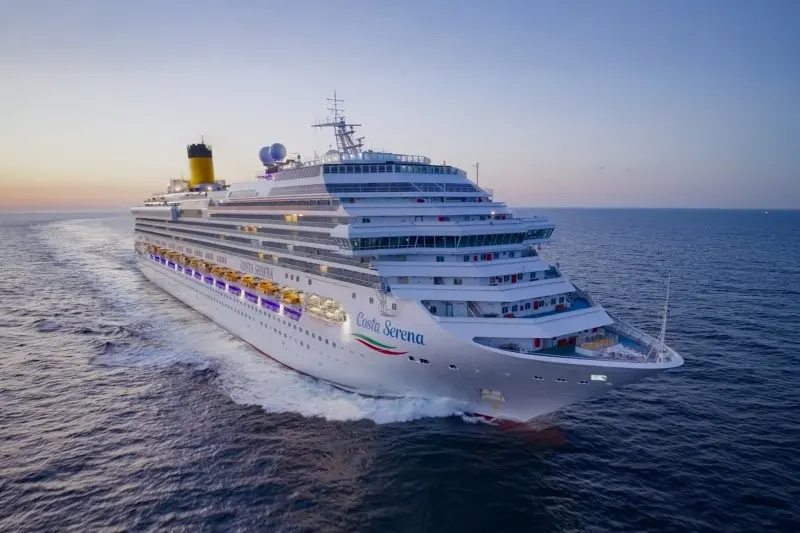
A 114,500-ton cruise ship is now part of the athletes' village setup at the 20th Asian Games. The Costa Serena docked at Nagoya's Kinjo Pier on September 15 and will stay there until October 6, 2026, serving as official accommodation for roughly 4,000 athletes and team officials from 43 nationalities competing at the Games, which run September 19 to October 4 in Aichi and Nagoya.
Costa Cruises chartered the vessel to the Games' organising committee, working alongside travel giant JTB Nagoya. The company says this is the first time a cruise ship has been used as a floating hotel for a major sporting event in Japan.
The ship got a serious overhaul to function as an athletes' base rather than a leisure resort. Cabins were assigned by sport instead of nationality so training and rest schedules line up. Meal times follow competition and training timetables rather than the usual cruise routine, and menus were redesigned around athletes' nutrition needs. Fitness areas were expanded with dedicated training zones, while the pools, thermal suites and quiet lounges were repurposed as recovery spaces. A fully staffed medical centre operates on board in coordination with the Games' medical services, covering competitors across 18 disciplines.
Costa's chief commercial officer Francesco Muglia framed the conversion as a natural extension of what cruise lines do daily: feeding, housing and managing thousands of people at once. The difference, he noted, is that an athlete racing the next morning needs meals on schedule, a place to train, proper recovery and a quiet cabin — not a show in the theatre.
For Costa, the charter is also a showcase. Asia regional director Francesco Raffa argues the model proves a cruise ship can deliver temporary large-scale accommodation, dining, training and social space in one place, without building anything permanent. With host cities increasingly wary of white-elephant venues and hotel shortages during mega-events, floating hotels may get more chances to prove the concept.
For travellers, the takeaway is twofold. First, if you're heading to Nagoya for the Games, the waterfront around Kinjo Pier will host one of the event's most visible landmarks — a spectacle worth a look. Second, Japan's ports are clearly open to cruise ships in unusual roles, a hint of how the country is scaling up capacity ahead of a busy decade of international events.