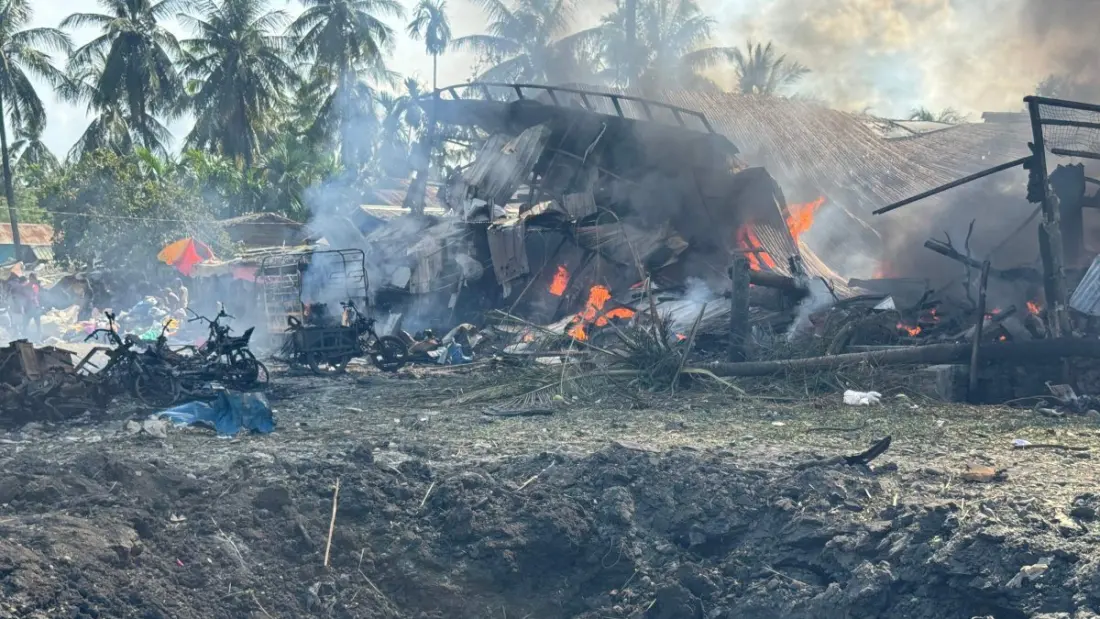
An airstrike on a crowded market in western Myanmar has killed at least 50 people and left the Philippines, current chair of ASEAN, offering to broker fresh regional talks on the country's deepening crisis.
The Sept. 28 attack hit Kyauktaw, a town in Rakhine state near the Bangladesh border, around midday when the market area was full of vendors and shoppers. The Arakan Army, the ethnic armed group that controls much of the state, said a military fighter jet dropped two bombs near the market and a nearby bridge. Myanmar's military has not commented. Local rescue teams first reported 33 dead, but the toll climbed to 50, with 58 wounded — some critically — and fires complicating the recovery of bodies. It ranks among the deadliest recent airstrikes in Rakhine, which has seen some of the fiercest fighting since the February 2021 coup.
From Manila, the Philippines' Foreign Affairs Assistant Secretary for ASEAN Affairs, Ana Marie Hernando, said the country was closely monitoring the situation and expressed concern over the loss of life. Manila says it will respect the bloc's consensus-based approach and the positions of fellow member states, while offering to facilitate discussions on assistance — consistent with ASEAN's stated aim of a solution that is 'Myanmar-owned and led.'
The broader picture remains grim. The Arakan Army has seized large parts of Rakhine since launching an offensive in late 2023, pushing the military to lean increasingly on air strikes and artillery in areas it has lost. The UN estimates nearly 3.8 million people are internally displaced across Myanmar, and 16.2 million need humanitarian aid; conflict monitors put the death toll since the coup above 100,000. ASEAN's main framework, the 2021 Five-Point Consensus, has made little headway, with member states still divided over how hard to push the military leadership.
For travellers, the takeaway is straightforward: Myanmar remains off-limits as a leisure destination. Several governments, including the US and UK, advise against all travel to the country, and Rakhine state in particular is an active conflict zone with severely constrained humanitarian access. The instability also touches neighbours — border areas with Bangladesh, Thailand and India see displacement and occasional spillover — though mainstream tourist circuits in Thailand, Vietnam and the Philippines operate normally. Anyone with trips booked in the wider region has little practical cause for concern beyond avoiding Myanmar itself and monitoring official advisories.