
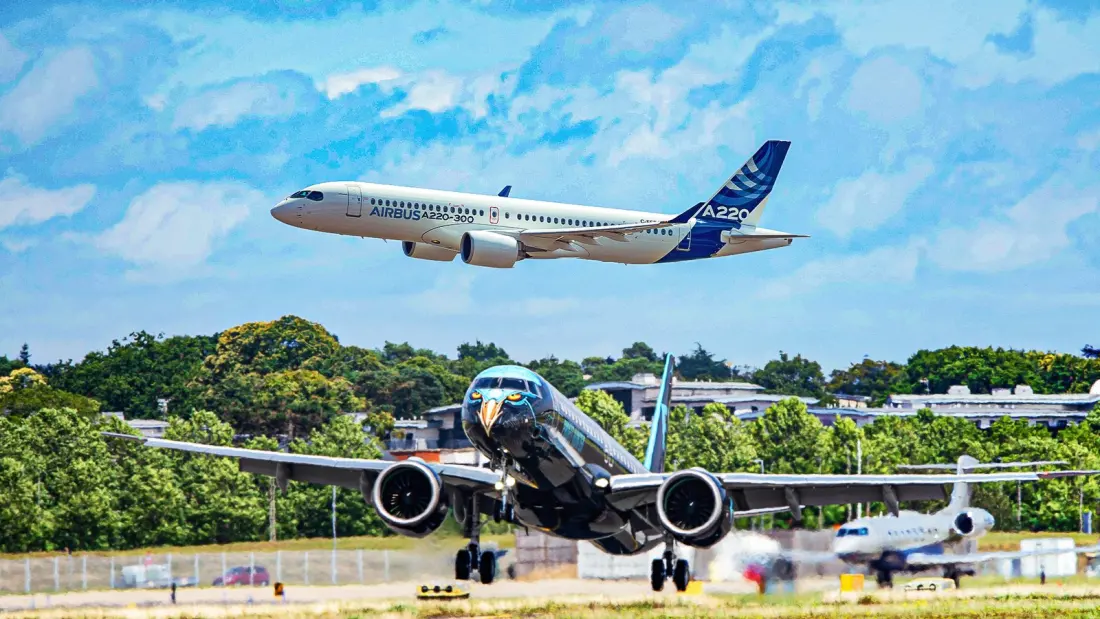
On 2 September, Embraer handed over a milestone aircraft: the 2,000th E-Jet, an E195-E2 delivered to Azul, Brazil's largest airline by destinations served. It's a quiet but telling landmark in a rivalry that gets far less attention than Airbus versus Boeing, yet shapes the regional flights millions of travellers take every year.
The E-Jet story began in the 1990s, when Embraer realised its 50-seat ERJ145 had a ceiling. After losing a larger-jet order to Bombardier's CRJ700 in 1997, the Brazilian planemaker scrapped a planned derivative and went clean-sheet, unveiling the E170 and E190 at the 1999 Paris Air Show. The E170 entered service with LOT Polish Airlines in March 2004, followed by the E175 with Air Canada, the E190 with JetBlue and the E195. The four-abreast cabin — no dreaded middle seat — helped the family spread quickly. Today the fleet has logged roughly 48 million flight hours, carried over 2.85 billion passengers and served more than 90 airlines in over 60 countries. Big US regional players like SkyWest, Republic and Envoy keep the E175 especially busy, with around 603 still flying and 171 on backlog.
Airbus entered this space by inheritance. Bombardier launched the CSeries in 2008, but the programme stumbled — over a year passed without a firm order at one point, and Boeing's anti-dumping petition after Delta's order made things worse. Airbus took a majority stake in 2018, rebranded the jet as the A220, and added a second assembly line in Mobile, Alabama. Orders have since climbed past 1,000, boosted by AirAsia's 150-plane order in May and BermudAir's ten A220-300s at July's Farnborough Airshow.
So Airbus leads on paper for next-generation aircraft: the A220's order book outstrips the E2 family, which passed 500 orders in June 2026. But Embraer has something orders can't buy — two decades of operators, spare parts networks and pilot familiarity worldwide. Its E190-E2 launched with Norway's Widerøe in 2018 and the E195-E2 with Azul in 2019, with Porter Airlines (54 jets) and KLM Cityhopper among the biggest users. Embraer's commercial backlog stands at $15.1 billion, with 465 aircraft still to deliver. The E175-E2 is on hold, a sign of where demand actually sits.
Why should a traveller care? Because these two aircraft increasingly define short-haul and regional flying — think Porter in Canada, Azul in Brazil, Scoot in Singapore, Airlink in South Africa. The plane you get determines seat width, cabin quietness and whether you're stuck in a two-two with a middle seat or not. The good news: both the A220 and the E2 are among the most passenger-friendly jets in the sky, with wider cabins than older regional aircraft and five-abreast or four-abreast layouts that avoid the worst middle-seat outcomes. Expect to see a lot more of both over the next decade.