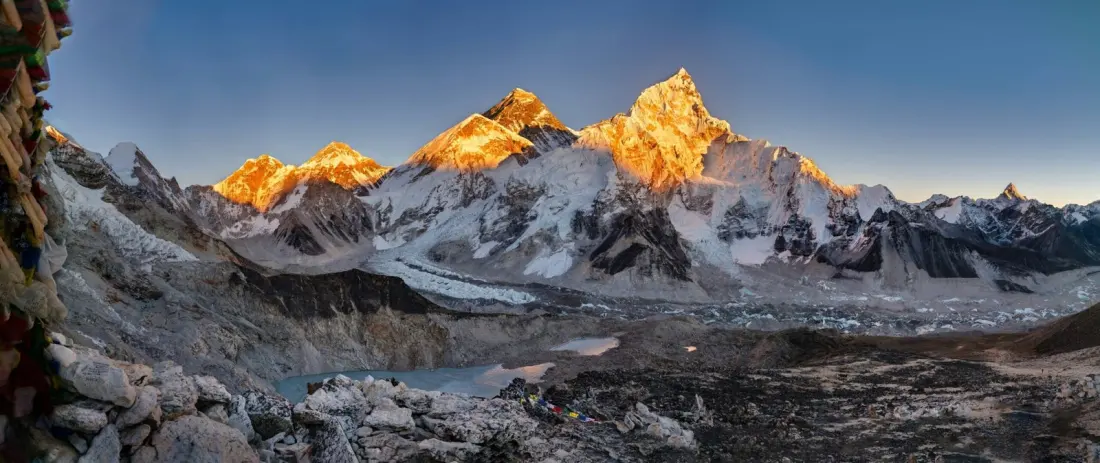
A new study published in Regional Environmental Change has put a startling number on one of Mount Everest's more overlooked problems: every spring climbing season, the hundreds of mountaineers and guides at base camp produce more than 6,000 litres of urine, which melts an estimated 154 tons of ice on the Khumbu Glacier. The liquid soaks straight into the glacier surface, and the repeated seasonal dose concentrates warming in a small, already-stressed zone.
Nepal's rules have moved on waste elsewhere — climbers must now haul their own faeces back down the mountain. Urine has no such rule, and with visitors told to hydrate heavily at altitude, most of it ends up on the ice. Beyond the melt itself, there's a pollution angle: contaminated water eventually reaches communities downstream.
The urine is only one pressure on an area that has become, in effect, a small temporary town. Base camp now runs around 1,600 heated and powered tents, plus Wi-Fi, coffee bars and big screens for clients who pay anywhere from €26,000 to €260,000 for a summit attempt. In 2023 that comfort came at the cost of 824 liquefied gas cylinders, over 5,000 litres of petrol and nearly 19,000 litres of kerosene. The consequences are measurable: base camp temperatures are rising at twice the rate seen across the rest of the glacier, and roughly three million kilograms of ice and snow vanish from the area each spring.
Scientists at ICIMOD, the Kathmandu-based research centre, warned back in 2014 that growing visitor numbers could bring more frequent avalanches, floods and landslides to the region. That warning looks increasingly prescient. On 26 August 2026, a glacier collapse on the China–Nepal border triggered catastrophic flash floods that killed more than 1,000 people.
For travellers, the story is a reminder that high-altitude tourism leaves a mark even when it looks clean — and that the world's most famous mountain route is physically changing, with meltwater now cutting through sections of the Khumbu Icefall. Anyone booking a trek to Everest Base Camp, even without climbing ambitions, should choose operators with genuine waste-management practices and expect a route that looks different from the guidebooks.