A century after Virginia Woolf argued in A Room Of One's Own (1929) that women need money and a room of their own to create, a Thai contemporary theatre work asks a harder question: even with access to both, do women truly own their most private space — their bodies?
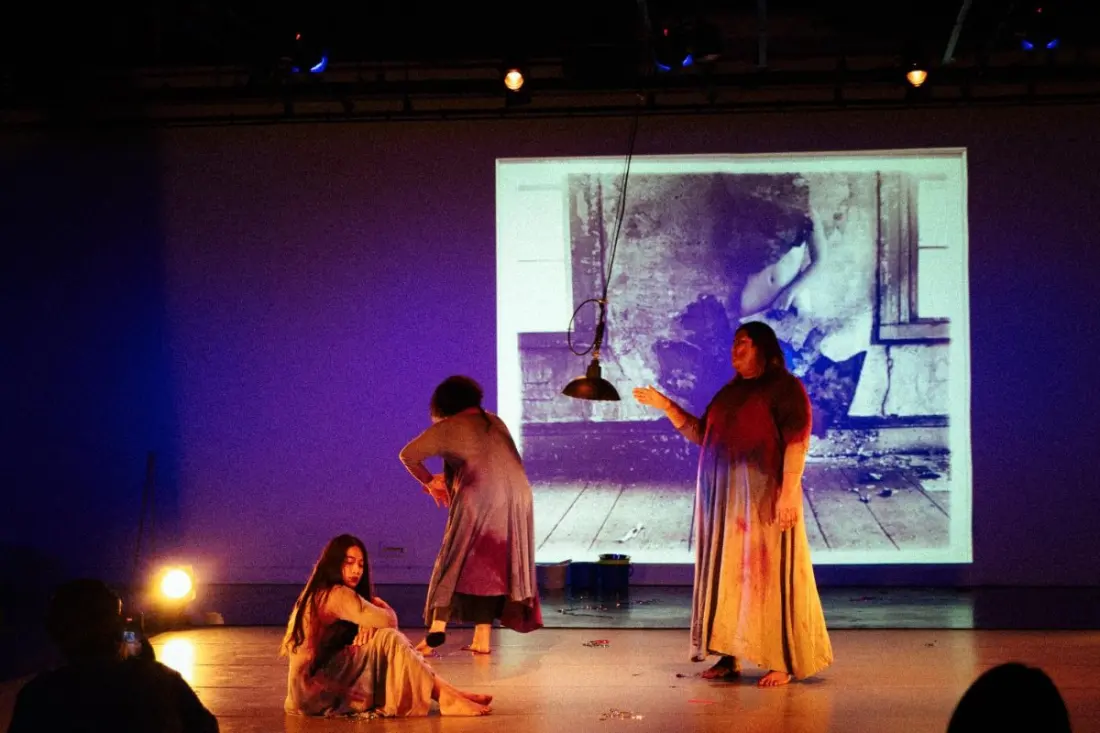
The Manifestations Of The No-Country, now running at the Bangkok Art and Culture Centre, brings together three theatre artists — Sukanya Phensirivijarn, Kanlaya and Patawadhamma Nopakhun — in a two-hour performance piece built around body movement. The show takes Woolf's feminist polemic as its starting point and pushes it further, exploring gender as fluid and transgressive, and framing body movement less as art form than as a metaphor for gender construction itself.
Staged colloquially and sometimes explicitly, the piece blurs theatre and reality. Audiences are allowed a voyeuristic peek into the performers' most private world — at one point invited to watch Miss Ot dress in a room, opening her robe to reveal her post-surgery breast. The border between stage and life wobbles; performers occasionally toss questions at the crowd or step offstage. Like gender, the production suggests, the theatre itself is a construct.
Each performer carries a different thread. Sukanya suffers the side effects of cancer treatment — breast removal, grey hair, hormone inhibition — and asks whether she becomes 'less of a woman' when medication blocks her female hormones, or when science insists on two sex categories. Kanlaya wrestles with material duties, while Miss Ot traces her own path through high heels, a wig, make-up at a boys-only school and a gender-affirming surgery, dragging on the floor as an anal cancer screening looms. Miss Ot reads an excerpt from Araya Rasdjarmrearnsook's novel aloud while Kanlaya scribbles in a stream of consciousness; later, she repeats the same sentence while caressing her imaginary pregnant belly, a disturbing refrain that breaks the script of patriarchal movement.
The staging leans on the image of a no-man's-land: a womb where scars and signs of age are not defects but vessels of personal history. Disruption and rupture run throughout — tango, floral swaying, dance — with the narrative fracturing into confusion and challenge. If becoming a woman is maintained by hegemonic binaries, the show argues, then it can be destabilised too.
Why should a traveller care? Bangkok's art scene offers far more than temples and street food, and BACC is its most accessible hub — free to enter, right by the BTS at Siam. A performance like this is a rare chance to see Thai experimental theatre grappling with gender, illness and identity in a country whose queer and trans communities are highly visible yet still fighting for bodily autonomy. Check BACC's listings for exact dates and ticketing before you go.