
Peter Heebink spent 45 consecutive winters pulling pulks across the frozen north — and he never once called them expeditions. "I don't call them expeditions because I had too much fun," says the 83-year-old, whose new book recounts more than 70 self-supported ski and snowshoe trips across the Yukon, Northwest Territories, British Columbia and Alaska between 1975 and 2020.
The numbers are striking: over 15,000km of backcountry travel, a longest journey of 800km in 35 days, and more than 160 different companions joining along the way. Heebink moved to the Yukon from the U.S. in the early 1970s, and when decent downhill slopes proved scarce, he switched to cross-country skiing — then discovered that winter camping itself was the real draw.
The gear evolution alone is a story. His first big trip in 1975 was a comedy of errors: heavy packs, leather boots, no skins, and skis so useless on unbroken snow that the group carried them on their backs and walked in snowshoes. A friend's early attempt at hauling a toboggan — a thin plastic Crazy Carpet strapped to a backpack — flopped all over the trail. By 1984, Heebink had cracked it: a chain of three or four small pulks, linked so they stabilised each other, hauled on a 400km journey from Old Crow to Herschel Island. "I felt liberated," he says. Everyone in his groups made the switch soon after.
The culture of the trips was as distinctive as the gear. Each winter he stitched together new routes through terrain of historical or cultural interest, and anyone willing to come along was welcome — no screening required. Disagreements were resolved quickly, and everyone learned to recognise what Heebink calls "the hate-the-person-in-front syndrome," the inevitable resentment toward whoever was breaking trail at the front of the single-file line that day.
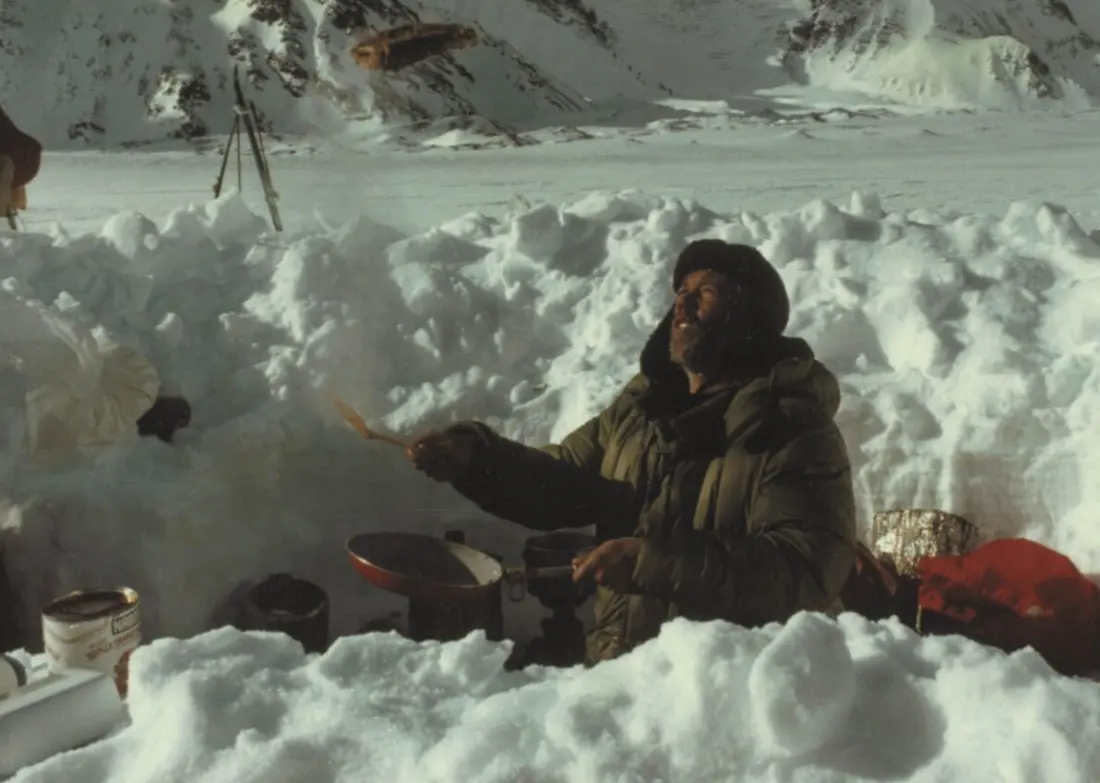
Evenings had their own rituals. The groups dug fire pits up to two metres deep to reach solid ground, since a fire built on snow just smoulders and sinks. A notched "dingle stick" held cooking pots at different heats and doubled as a drying rack for frozen boots and clothing. Each member had to bring at least one surprise for the group — a full roast turkey, a cocktail party kit, even a croquet set — and overproof rum flowed freely enough that, in Heebink's words, teetotallers at the start of a trip rarely lasted to the end.
Why does this matter to travellers? Because it's a refreshing counterpoint to expedition culture. Heebink logged genuinely serious distances in genuinely serious conditions, quietly, with no sponsors or world-first claims — just a campfire, good company and spectacular scenery. His book, Slogging North of 60: Half a Century of Ski Trekking Through the Yukon and Beyond, is both a warm read and a practical masterclass for anyone dreaming of their first winter backcountry trip, whether in the Arctic or closer to home.
Story via ExplorersWeb.