
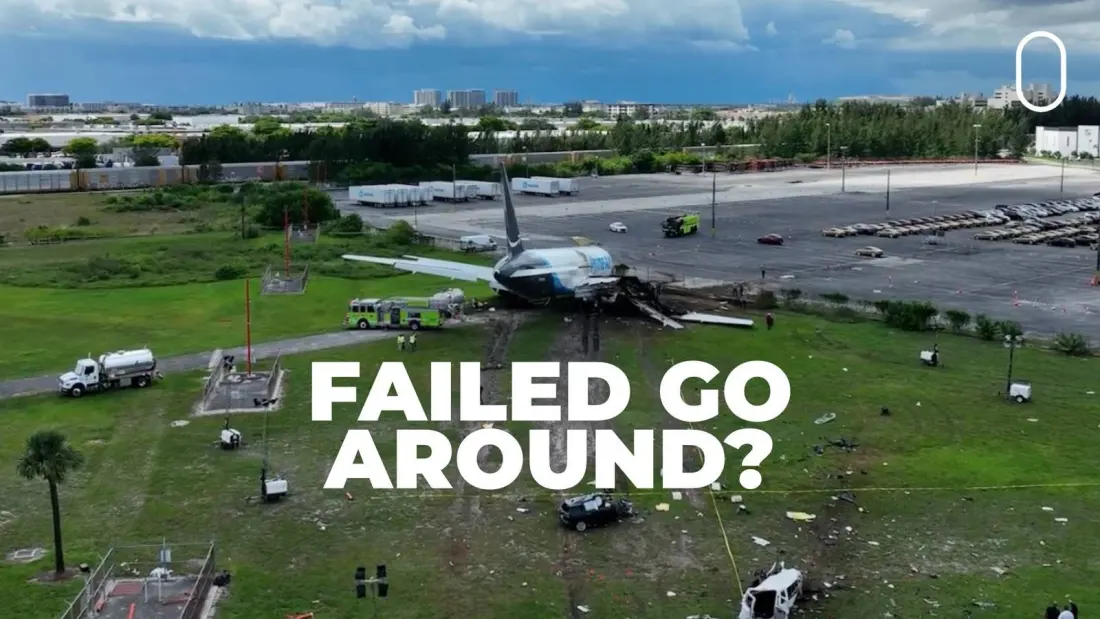
Almost two minutes of drama at Miami International Airport on 6 September has now been laid out in detail, as the NTSB published the final 30 seconds of flight data from the Amazon Prime Air Boeing 767 that ended up in trouble on landing. The recording answers a key question about what the two pilots were doing in the last moments before the aircraft ran off the runway.
The data shows a manoeuvre that started but never finished. Faced with an unstable approach, the crew pushed the thrust levers forward to go around — the standard move when a landing isn't looking right. Then, at the last moment, they changed their minds and tried to continue the landing instead. That late reversal left the aircraft in a bad compromise: too much power, too high a sink rate, and not enough runway left to sort it out.
What makes the findings more striking is what the pilots didn't do after touchdown. Neither thrust reversers nor speed brakes — the two systems that chew up most of a heavy jet's landing distance — were deployed. A 767 freighter landing without those aids needs far more tarmac than Miami's runway could offer, and the aircraft overran as a result. There were no fatalities in the accident, but the aircraft was damaged and the incident has become a case study in how split-second decisions can stack up.
Accident investigations like this one tend to stay in the aviation press, but they matter to anyone who flies. Go-arounds are one of the safest tools in a pilot's kit — and this incident shows why committing to one, rather than second-guessing it at low altitude, is drilled into airline crews worldwide. For passengers, the takeaway is reassuring in its own way: the system that flags unstable approaches and forces a decision works, and investigators examine every detail when it doesn't go to plan.
Miami is one of the busiest gateways between the US and Latin America, and cargo operations like Amazon's run through it around the clock alongside heavy passenger traffic. Runway overruns by freighters are rare, and this one caused no injuries — but it's a reminder that even at major international airports, the margin between a routine landing and a reportable accident can come down to a few seconds of hesitation.
For frequent flyers, the most useful takeaway isn't fear but awareness: if your flight goes around unexpectedly, it's usually because the system is working exactly as designed. The rare accidents happen when crews reverse that decision — which is precisely why the NTSB's publication of this data will feed into training at airlines and cargo operators for years to come.
Simple Flying