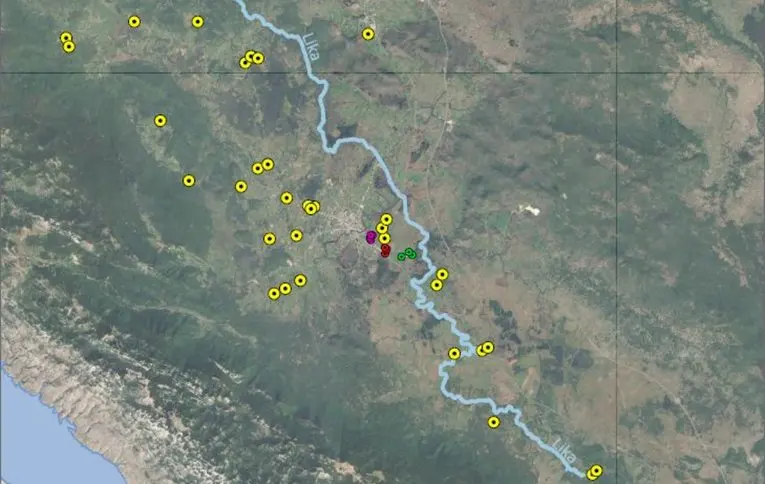
Croatia's water safety row has taken a new turn. The Croatian Institute of Public Health (HZJZ) and the Lika-Senj County public health authority have published results of emergency sampling around Gospić, confirming PFAS compounds — the so-called "forever chemicals" — in two private wells downstream of an illegal hazardous waste dump that has become one of the country's biggest political scandals.
Between 20 August and 9 September, testers sampled 43 private facilities: 38 wells, three cisterns and two springs. One well right next to the dump near Divoselo recorded a PFAS concentration of 0.3018 µg/L — three times the legal limit of 0.1 µg/L. A second well showed 0.0265 µg/L, within limits. Authorities say both owners are connected to the public supply and don't drink from their wells. Of the remaining sites, 33 showed only the ordinary microbiological issues typical of untreated water, and elevated readings in 10 others were put down to the natural chemistry of the karst terrain rather than dumped waste.
The context matters. As much as 37,000 tonnes of hazardous waste was illegally buried at Divoselo and Benkovačko Selo near Gospić, triggering a criminal investigation and mass protests in Zagreb. An expert report from the Josip Juraj Strossmayer Water Institute found that water passing directly beneath the Divoselo dump carries 89 percent of the detected plastic — 737 micrograms of Styrofoam per litre — plus Teflon-type PFAS compounds, with the Lika River noted as a directly connected water body. Meanwhile, Prime Minister Andrej Plenković has set up a Scientific Council, which he chairs personally, to interpret the findings publicly — a move critics see as damage control, since it has no obligation to publish minutes or dissenting opinions.
For visitors, the practical message is straightforward: HZJZ insists the pollution is strictly local, and that regular testing confirms the public water supply across Lika-Senj County — including the holiday islands of Pag and Rab — is completely safe. PFAS didn't turn up in any wells beyond the two near the dump.
Why should travellers care? Lika is the karst hinterland many people drive through on the way to the Adriatic, and it's increasingly visited for Plitvice Lakes, Velebit hiking and rural guesthouses — where private wells are common. If you're staying in a rural property in this part of Croatia, it's reasonable to ask your host about the water source. Public supply: fine. Untreated private wells anywhere in a karst region: worth a question, dump scandal or not.
The story is still moving. Remediation of the site has yet to begin, monitoring continues, and the political pressure isn't going away. Anyone planning trips through the Gospić area this year should follow local reporting, but there's no indication that holidays in Lika-Senj, Pag or Rab need reconsidering.
Reporting via Total Croatia.