
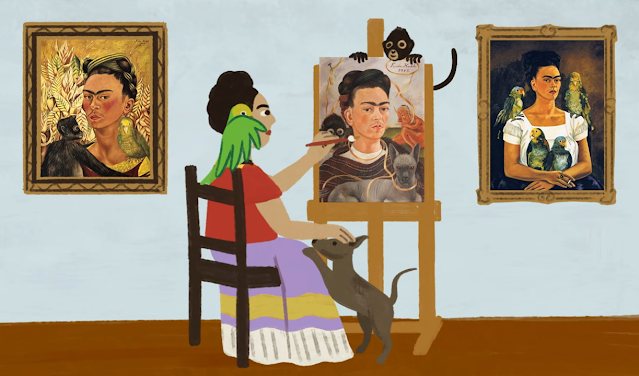
A short animation from Tate Kids has been retelling the life of Frida Kahlo for young audiences — but it's winning adult fans too. Without talking down to anyone, it traces the arc of the Mexican painter's life from a plant-collecting childhood to global icon, and it's a lovely primer before a trip to Mexico City, where Kahlo's world is very much on show.
The story it tells begins in 1907, when Kahlo was born into a household where her father painted and her mother passed on Mexico's indigenous traditions. Polio struck at six, leaving one leg longer than the other and drawing cruel teasing from classmates. Her response set the pattern for a lifetime: she invented an imaginary friend, and her father encouraged her into sport to rebuild her strength.
Then came the moment that shaped everything. At 18, she was in an accident that fractured her spine and left her in a plaster cast. It's in the long, difficult recovery that painting stops being a hobby and becomes the spine of her life, figuratively speaking. Over the following decades she would endure more than 30 operations, and painting stayed with her through all of it — a way to process pain that produced some of the most instantly recognisable art of the 20th century.
What the animation gets right, its admirers say, is tone. It doesn't sanitise the suffering or over-dramatise it. It simply shows how joy, pain, colour and courage coexisted in one life, and why the work still resonates with artists and art lovers more than half a century after her death.
For travellers, Kahlo's Mexico City is an easy itinerary to build. Her family home, the Casa Azul in Coyoacán, is now the Frida Kahlo Museum, its cobalt-blue walls filled with her paintings, clothes and belongings. Pair it with the nearby Trotsky house, the colourful Coyoacán market, and Diego Rivera's murals dotted across the city centre, and you have a full day (or two) of following in her footsteps. The video itself is worth ten minutes before you go — knowing the story makes the rooms of Casa Azul land differently.
Kahlo's appeal goes beyond the canvases. She turned limitation into style, politics and identity, and that's why her face shows up everywhere from tote bags to museum blockbusters. The animation is a reminder that the story behind the image is darker and tougher than the merch suggests — and a nudge to see the real thing where it was made.