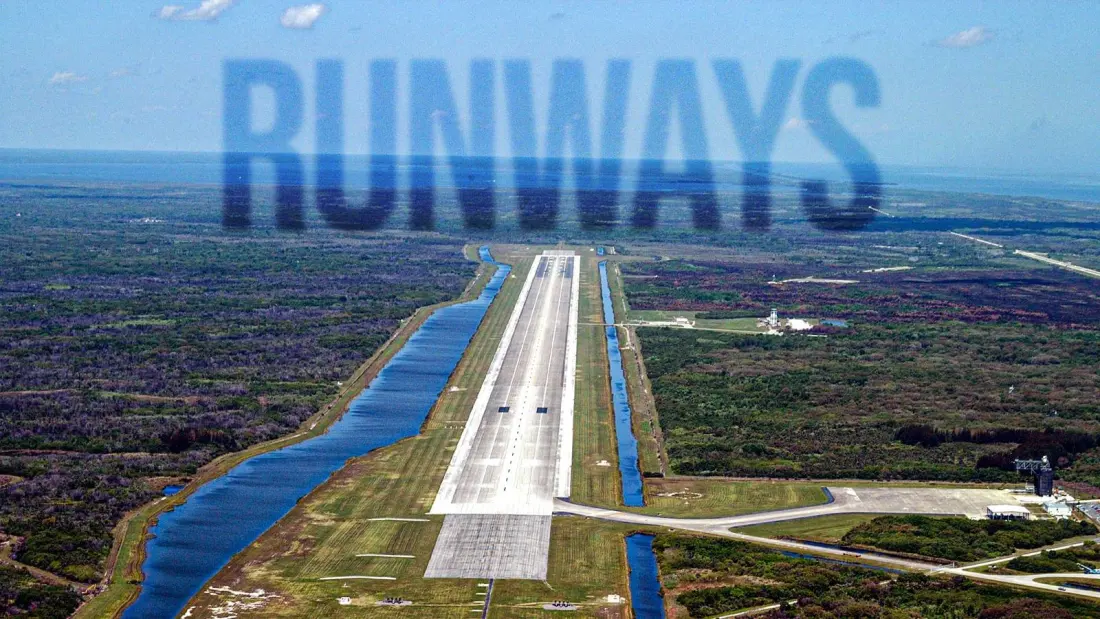
Some of the world's longest commercial runways were never built for airliners. During the space shuttle era, NASA needed emergency strips for returning orbiters — unpowered gliders that got exactly one shot at landing, with no go-around option. A handful of civilian airports made the cut, and today holidaymakers land on the very same tarmac that once stood ready for astronauts.
The list starts in the mid-Atlantic. Lajes Field on Terceira Island in the Azores runs to 12,109 feet (3,691 m) and served as a transoceanic abort landing site — a lifeline for crews who'd otherwise face an ocean ditching during an early launch failure. It now operates as a joint military and commercial airport, its over-engineered pavement handling widebodies with ease.
Spain has two entries. Zaragoza Airport, also 12,109 feet, needed zero modifications to qualify as a NASA abort site thanks to its length and position under launch trajectories; it's now a busy joint civilian-military hub. Torrejón Air Base near Madrid goes further still — 15,803 feet (4,817 m), among the longest paved surfaces in Southern Europe — though it has largely returned to military use.
The headline numbers belong elsewhere. Denver International's Runway 16R/34L stretches 16,000 feet (4,877 m), built not for spacecraft but to compensate for Denver's mile-high altitude, where thin air and hot summer days demand extra takeoff roll. Upington Airport in South Africa's desert edges past it at 16,076 feet (4,900 m) — and unlike Denver, it was a formally designated NASA backup recovery site, chosen to give the agency southern-hemisphere coverage. The same thin, hot air that challenges airliners helped slow a descending orbiter.
The crown goes to Ulyanovsk Vostochny in Russia: a colossal 16,404-foot (5,000 m) strip, paved in 1983 to flight-test the Antonov An-124 at maximum weight and later designated as an alternate landing zone for the Soviet Buran shuttle. It's now the main base of cargo operator Volga-Dnepr.
For travellers, the most accessible of these giant runways double as genuine gateways. The Azores are a growing eco-and-hiking destination, and Zaragoza puts you within reach of Aragón's Mudejar architecture and the Moncayo mountains. Even without a boarding pass, the story adds a layer to any trip: the tarmac under your feet in Terceira or Zaragoza was once part of the safety net for a spacecraft falling out of orbit.