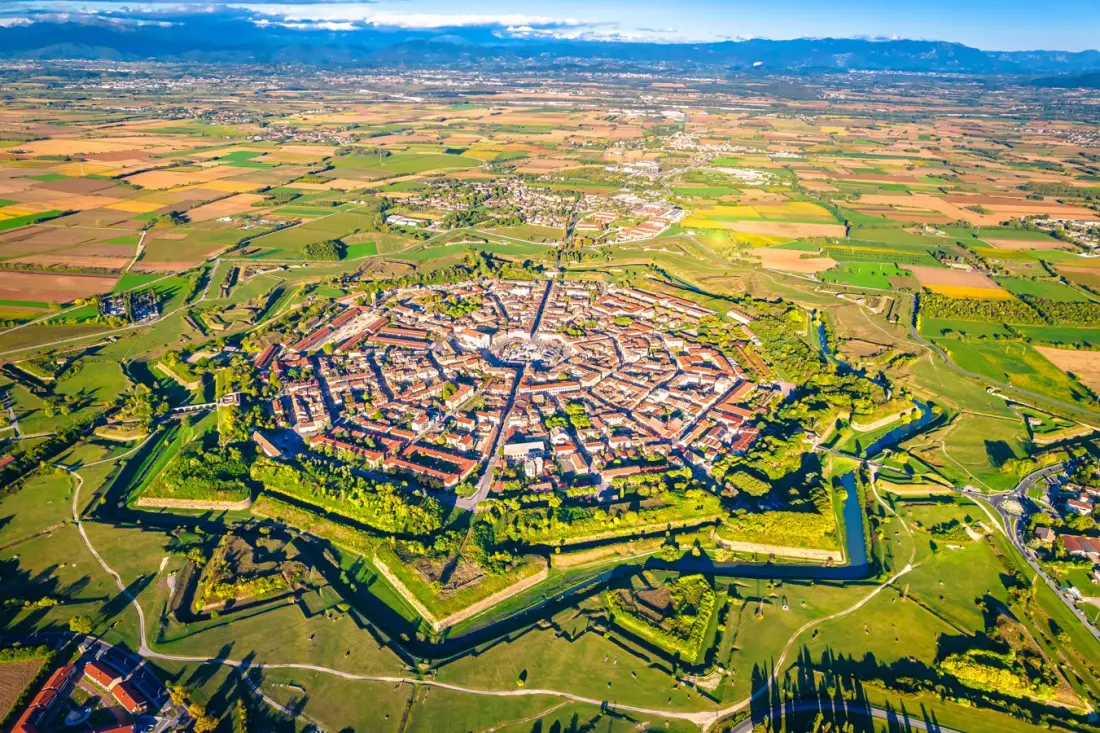
Some towns grew organically over centuries. Palmanova was drawn first. Built in 1593 by the Venetian Republic, this fortress city in Friuli-Venezia Giulia is laid out as a perfect nine-pointed star, a design that was equal parts military engineering and Renaissance philosophy. Venetian planners wanted an impregnable stronghold near the Ottoman frontier, and utopian thinkers of the era saw a symmetrical city as a blueprint for an ideal society. Both ideas left their mark.
The star shape wasn't decoration. Angled bastions let defenders cover every approach with cannon fire, and the design worked: the city shrugged off sieges and invasions for centuries, surviving everything from Ottoman raids to a brief Napoleonic occupation. Today the walls, moats, and three grand gated entrances — Porta Udine, Porta Aquileia, and the most striking of the trio, Porta Cividale with its rounded arch and guard walkways — still ring the town, completely free to explore on foot.
The best way to grasp the geometry is from the ground up. Piazza Grande, the hexagonal central square, echoes the star theme, and the stately Palmanova Cathedral anchors it. For something darker, book the Underground Countermine Tunnels, dug in the 17th century so troops could move and stash weapons where enemies wouldn't think to look. Self-guided audio tours run in Italian, English, and German, ending in a guard lodge with a sweeping lookout over the star-shaped streets. A €12 combined ticket bundles the tunnels with the Baluardo Donato bastion, a multimedia video room, and the Virtualift.
If you'd rather stay outdoors, a grassy trail wraps the entire perimeter — walk it, run it, or bike it. The gentle green embankment and a calm river were once deliberate camouflage, and now they make for one of the more pleasant rampart circuits in Italy.
Then there's the surprise twist: Palmanova is also a shopping stop. The Palmanova Designer Village packs around 90 outlets selling Italian and international fashion, shoes, and chocolate at discounted prices, so you can pair a morning of military history with an afternoon of cut-price retail. That combination — Renaissance fortifications plus outlet bargains — makes the town an easy detour on a road trip between Venice and Trieste, or a half-day trip from Udine.
Plan on two to four hours for the essentials, or a full day if you add the museums and a complete circuit of the walls. Spring and early autumn are the sweet spots for walking the ramparts without melting. Entry to the city, the square, and the fortifications costs nothing, which makes Palmanova one of the better-value oddities in northern Italy — a town planned like a weapon and experienced like a park.
Story credit: Unusual Places.