
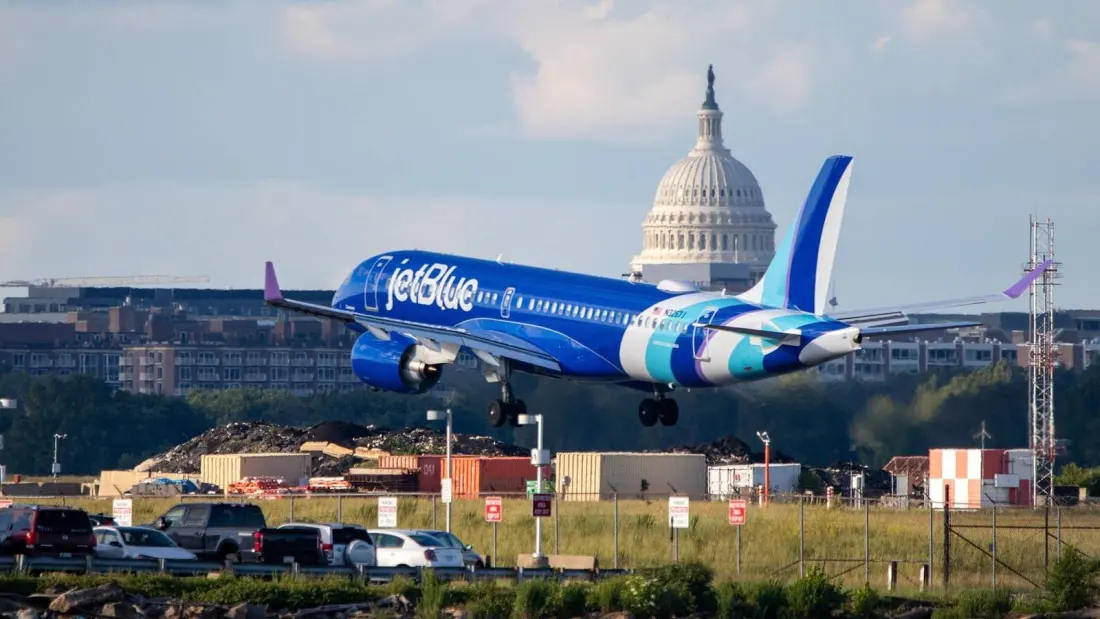
Flying from Washington's closest airport to the capital may soon get harder. Two US senators have introduced the DCA Air Safety Act, a bill that would slash a large share of long-distance flights from Ronald Reagan Washington National Airport (DCA) and cap how many planes can land each hour.
Virginia Senators Tim Kaine and Mark Warner put the bill forward after January's deadly midair collision between American Airlines Flight 5342 and a US Army Black Hawk helicopter over the Potomac River, which killed 67 people. Both argue the airport — which sits right beside restricted airspace and is already running beyond capacity — is simply too crowded to operate safely at current levels.
The specifics: arrivals would be capped at no more than 28 per hour, down from roughly 30, with mandatory intervals between clusters of takeoffs and landings. On top of that, six airport slots would be cut every year from 2028 through 2032, removing 30 slots in total. The Federal Aviation Administration would decide which flights lose their slots, and the process would be public, with a 60-day window for comment. Congress would also receive regular reports on traffic levels and operational safety at the airport.
The cuts would fall hardest on flights beyond the airport's famous 1,250-mile perimeter rule — the longer routes that have been gradually added to DCA over the years. Since 2000, the airport has gained more than 64 daily slots, and it is now one of only three fully slot-controlled airports in the US, alongside New York JFK and LaGuardia. The senators also point to strained air traffic control staffing: during one stretch around the time of the collision, a single controller was tracking 29 different aircraft within a five-minute window.
For travellers, the practical impact depends on where you fly. If the bill passes, nonstop options from DCA to destinations far from Washington — think Denver, Austin, San Antonio, Salt Lake City or similar long routes that have been added under perimeter exceptions — could shrink sharply. The workaround isn't complicated but it is less convenient: the Washington area is served by three airports, and nearby Dulles International (IAD) handles more passengers than DCA, at roughly 27.9 million in 2025 versus DCA's 24.9 million. Baltimore/Washington (BWI) carries a similar number. Anyone who regularly uses DCA for flights past the perimeter should keep an eye on the FAA's slot decisions if the legislation moves forward.
There's no guarantee the bill becomes law, and airlines that hold those valuable long-haul slots will no doubt fight it. But the political momentum after the Potomac collision is real, and Warner has been blunt about the stakes: Congress cannot wait for another tragedy before acting. For now, nothing has changed at the airport — but travellers booking DCA's longer routes in the next couple of years may want to stay flexible.