
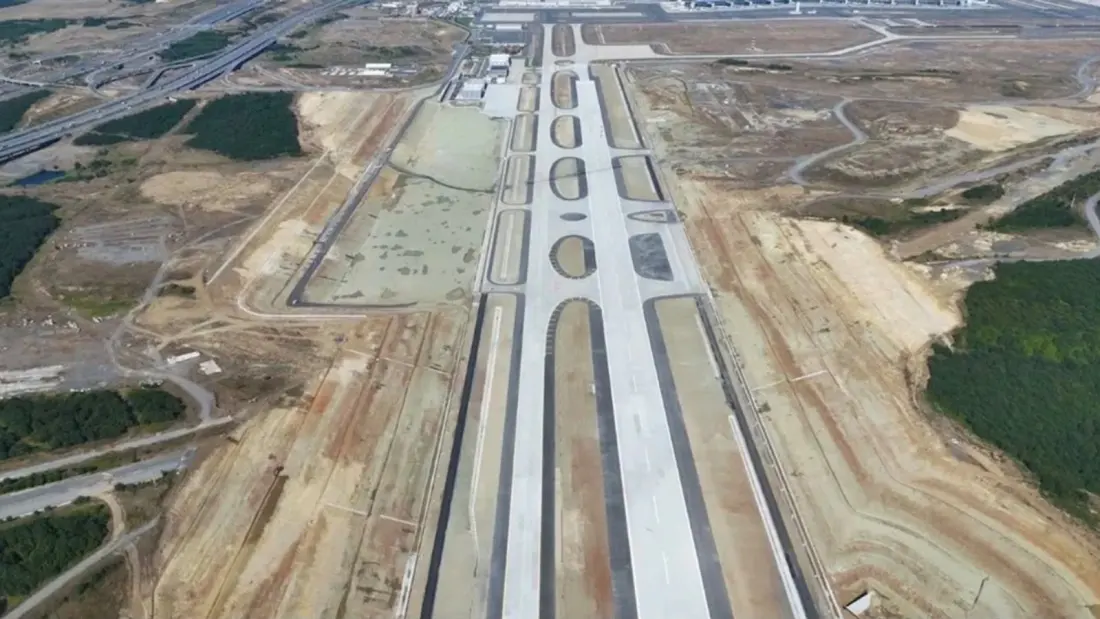
Istanbul Airport has switched on a fourth main runway, and for the first time it runs east-west rather than north-south. Officials announced the opening on Friday, saying the addition should cut taxiing and airborne times and save airlines real money on fuel.
The new strip is 2,820 metres long and 45 metres wide, bringing the hub's total to six runways — four main and two reserve. It will mainly handle departures towards Anatolia, Central Asia and the Arabian Peninsula, according to Transport and Infrastructure Minister Abdulkadir Uraloğlu. Because planes can now roll east or west for takeoff, they no longer need to swing back east after leaving the runway, which trims minutes off flights on domestic and eastbound routes. For now it's takeoffs only, with simultaneous four-runway operations planned further down the line.
It's another milestone for an airport that has moved fast since fully opening in April 2019. In April 2025 it became the first in Europe to run three independent parallel runways at the same time, and the master plan eventually calls for nine runways — six main, three reserve. Capacity in the current phase is 90 million passengers a year, with a long-term ceiling of 200 million once everything is built.
The timing is telling. An OAG report released this week named Istanbul the world's most internationally connected airport, with potential connections to 337 destinations, nudging London Heathrow off the top spot. Turkish Airlines operates around 80% of flights there. Istanbul also recently passed Heathrow as Europe's busiest airport by passenger numbers — something industry watchers, including Heathrow's own chief executive, had predicted would happen around now. In 2025 the airport served a record 84.5 million passengers, making it second-busiest in Europe and eighth worldwide, and it's targeting 90 million this year.
The runway fits into a broader Turkish aviation build-out. The country now has 58 active airports, up from 26 in 2002, with two more under construction. Passenger traffic across domestic and international routes hit a record 247 million in 2025, ranking third in Europe and seventh globally.
For travellers, the practical upshot is smoother connections. If you're transiting through Istanbul — whether onwards to Tashkent, Riyadh or a domestic hop to Cappadocia — the new departure direction should mean fewer delays and tighter connection windows becoming genuinely feasible. And with 337 destinations on the board, the airport's role as a one-stop bridge between Europe, Asia and the Middle East is only getting stronger.
Story via Daily Sabah Travel.