
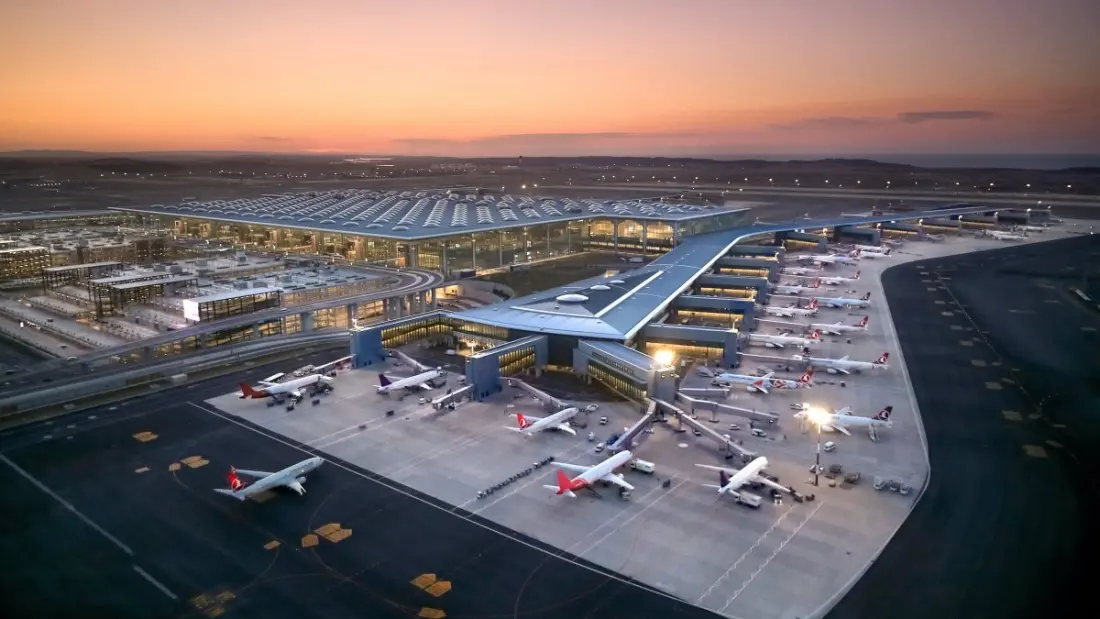
Istanbul Airport has claimed the top spot in OAG's Megahubs 2026 ranking, nudging London Heathrow into second place for the first time. The airport now offers possible connections to 337 global destinations, a reach that comes almost entirely thanks to Turkish Airlines, which operates 80% of all flights there.
The ranking counts the number of possible inbound-to-outbound connections within a six-hour window on the busiest travel day of the year (Sunday 2 August), plus the number of destinations served. Heathrow's potential connections dropped 6% year-over-year, partly due to ongoing disruption to Middle East schedules. Amsterdam Schiphol took third, growing both connections and destination count.
It's been a landmark stretch for Istanbul overall. The airport recently overtook Heathrow as Europe's busiest by passenger numbers, and it handled a record 84.4 million travellers in 2025, making it second-busiest in Europe and eighth worldwide. It's aiming for 90 million this year. Fully operational since April 2019, the glass-and-steel complex on the Black Sea coast currently handles 90 million passengers annually in its present phase, with a design capacity of 200 million once all phases are complete. IGA CEO Selahattin Bilgen credited the airport's forward-planned layout and Istanbul's east-west geography for the climb.
Elsewhere in the top 10: Kuala Lumpur held fourth and stayed Asia's most connected hub with 154 destinations, Chicago O'Hare jumped from seventh to fifth as the Americas' leader, and Frankfurt and Paris Charles de Gaulle also featured. Chicago expanded to 308 destinations, the third-widest reach globally behind Istanbul and Frankfurt's 310. China made notable gains — Shanghai Pudong rose to 14th, Guangzhou Baiyun leapt from 36th to 19th, and Hong Kong re-entered the top 20.
The budget side of the report is just as telling. Kuala Lumpur topped the low-cost carrier index with nearly 15,000 possible budget connections, and Asia-Pacific accounted for 64% of the top 25 low-cost airports. Low-cost carriers now hold 51% of seats in Southeast Asia, well above the 34% global average.
Why does this matter to travellers? A hub this connected means Istanbul is arguably the easiest single stopover point on earth if you're flying between Europe, Asia, Africa and the Middle East. Turkish Airlines' network makes multi-stop itineraries on one ticket simple, and the airport itself is built for long layovers, with plenty of dining, shopping and lounges. If your route offers a choice of connections, Istanbul now edges out London for sheer number of onward options.