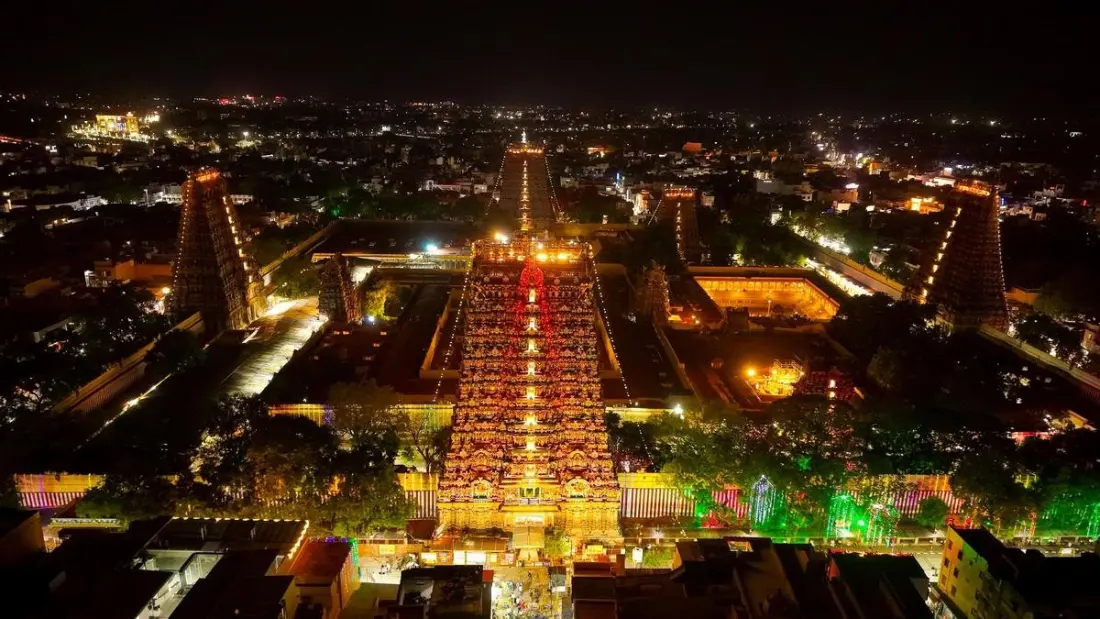
Madurai is famous for one very big temple, but a local's-eye view of the Tamil Nadu city turns up far more — a guide published ahead of the Kumbabhishekam rounds up the food, crafts and history that most visitors walk straight past.
Start with the saris. The city's sungudi tie-and-dye tradition came with the Saurashtrian community, who migrated from Gujarat in the late 16th and early 17th centuries and flourished under Nayak rule. Only a handful of families around the Mahal area still work by hand; most of what you see now is machine printed. To watch the process up close, Cholan Tours Madurai arranges visits, and Tharagai Sungudi in BB Kulam — which trains around 20 local women — sells authentic saris from ₹2,000 to ₹15,000, Monday to Friday.
Then there's the heat, and Madurai's answer to it: jigarthanda, a caramel-coloured dessert drink made with badam pisin (a jelly-like almond gum), ice cream, basundhi and nannari syrup. Famous Jigarthanda started as a push-cart on Kamarajar Street in the 1970s and now runs 20 branches. The original spot is always packed but worth the squeeze.
For food with a side of people-watching, Teppakulam — the historic temple tank — comes alive every evening with stalls selling sweet polis, fresh bajjis and puttu, plus fairground rides and a central mandapam shaded by trees. Evening push-carts, appearing around 7pm near the temple and Tirumalai Nayak Mahal, sell mullu murungai keerai vadas, a green puffed snack brought by the Saurashtrians, at three for ₹10. Pair them with paruthipaal, a thick cottonseed drink, from Sri Sastha Paruthipaal, a 90-year-old shop on Netaji Road. Shankar Coffee Bar near Anna Bus Stand does some of the city's best vadas and chutney.
Madurai's jasmine is a headline act in itself — Madurai malli is GI-tagged for its fragrance and round shape, and exported as far as Singapore, Malaysia, West Asia and the US. The flower markets at Mattuthavani and Villapuram are hillocks of jasmine, mullai, sampangi, rose and marigold, with women stringing garlands at remarkable speed.
History runs deep here. At Keeladi, 12km from the city, excavations have uncovered artefacts from a Vaigai valley civilisation dating back 2,000 to 2,500 years — the oldest to around 580BC. The site is open 10am to 6pm on weekdays, till 7pm on weekends, with a ₹15 entry fee. Back in town, Pathu Thoon Street's marketplace pillars belong to an extended Nayak-era palace, and the unfinished Raya Gopuram near the Meenakshi temple still looms over a busy street. The Gandhi Memorial Museum holds the blood-stained cloth from his assassination in 1948; it was after a visit to Madurai that Gandhi adopted his simple attire.
One more excursion: Samanar Malai at Keelakuyilkudi village, 15km out on the Madurai-Theni highway. A climb of 100-plus steps up a 2,000-year-old Jain hillock reveals bas reliefs of Mahavira and Gomateshwara, 9th- and 10th-century inscriptions and a Brahmi inscription higher up. Open 6am to 6pm, entry free.
This is a city best explored slowly, on foot and on an empty stomach — ideal for travellers who like their sightseeing seasoned with street food and living craft traditions.