
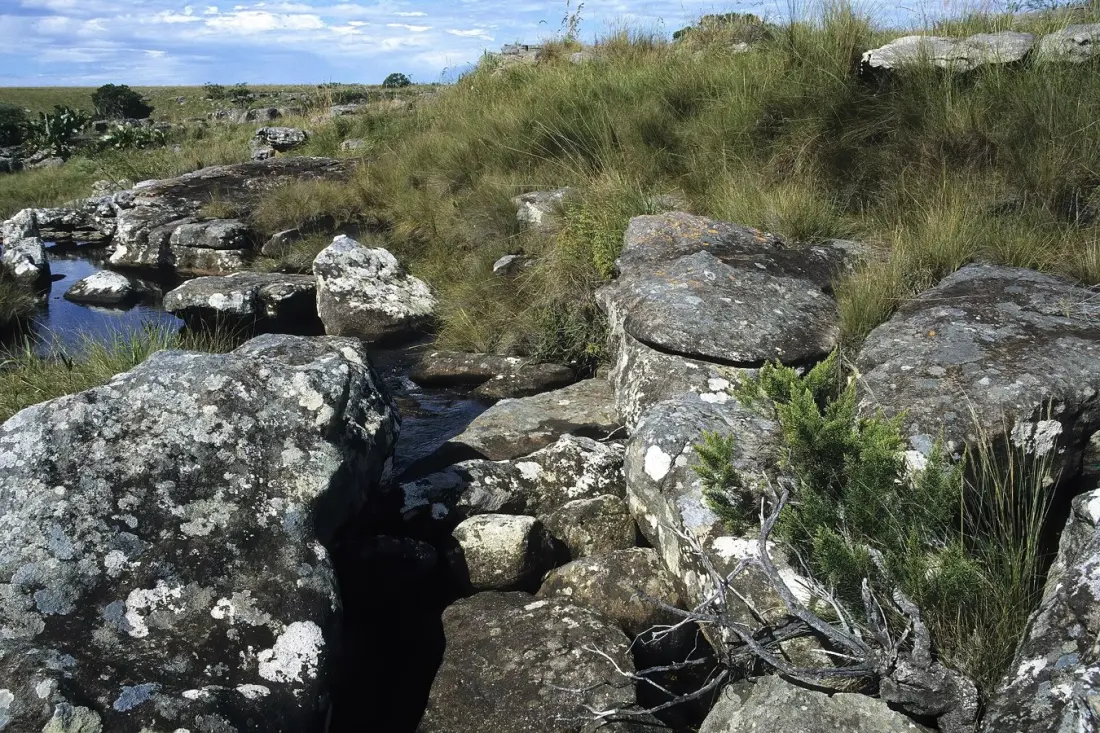
A stretch of South Africa's Wild Coast just picked up an international badge. In 2025, Mkhambathi Nature Reserve became the country's 31st Ramsar Site — the first Wetland of International Importance in the Eastern Cape — putting formal recognition behind the rare wetlands, estuaries and swamp forests packed into this remote coastal wilderness.
The reserve covers 7,720 hectares of grassland, forest and shoreline between Port Edward and Port St Johns in north-eastern Pondoland, roughly 71km from Flagstaff. It isn't a Big Five safari and doesn't try to be. Its draw is the combination of game and sea: eland, red hartebeest, blue wildebeest, blesbok and gemsbok graze open grasslands with the Indian Ocean as a backdrop, and game drives sit alongside a network of walking routes.
Waterfalls are the headline act. The Mkhambathi River steps down through a chain of pools and falls before meeting the sea, with Horseshoe Falls the best known — the river spilling over a sandstone terrace in a wide arc. Strandloper Falls and Mkhambathi Falls sit further downstream. Horseshoe Falls is reached on foot along the river, so the walk itself becomes part of the outing. Pack swimmers and a picnic; just remember this is genuine wilderness, not a groomed attraction, so stick to designated routes and check conditions before you go.
The coast earns its time too. Around 10km of rocky beaches and sandy coves sit below grasslands and forest, good for beachcombing, photography and long walks. Fishing and diving are possible in designated areas with permits, and whales and dolphins pass offshore in season. Birders should bring binoculars: the reserve records Trumpeter Hornbill, African Fish Eagle, Crowned Eagle, Gurney's Sugarbird and Greater Double-collared Sunbird, among others, while the nearby Mtentu and Msikaba gorges hold threatened Cape Vultures.
Accommodation is inside the reserve — the Main Lodge and Stone Cottage, plus rondavels and larger lodges in the GweGwe area. Don't count on shops or restaurants nearby; the remoteness is the point. Access runs off the R61 towards Holy Cross Hospital, with the final approach on gravel roads, so a suitable vehicle is essential. Fishing permits are required and some activities need approval from the Eastern Cape Parks and Tourism Agency, which is worth contacting before you travel.
Mkhambathi suits families after simple outdoor time, couples who want a quiet stretch of coast, and photographers or birders happy to go slow. There's enough to fill days — hiking, swimming, canoeing, wildlife — without any pressure to fill hours. The Ramsar status adds weight: this isn't just a pretty corner of the Wild Coast, it's an ecosystem of international significance, and visiting it means seeing a protected landscape at its rawest.