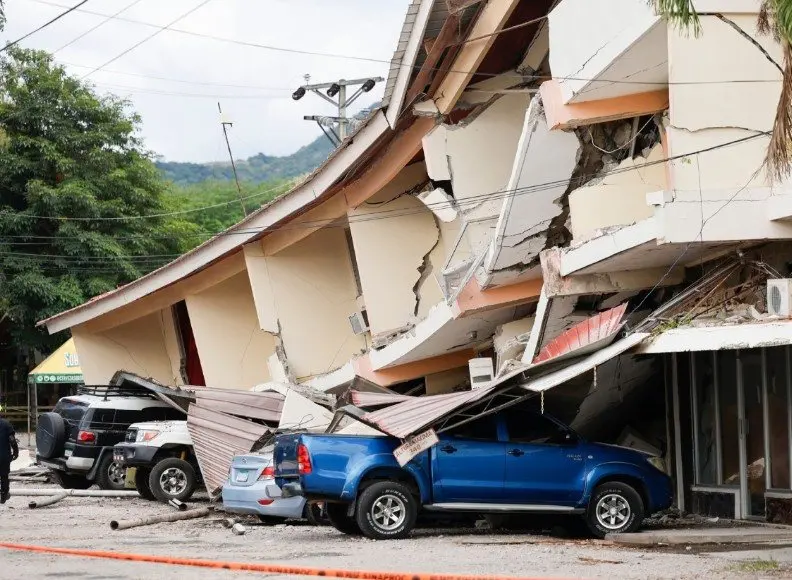
A magnitude 7.7 earthquake struck off Panama's southern Pacific coast on Friday morning, the most powerful shake the country has felt in years — followed hours later by a second major quake and dozens of aftershocks.
According to the U.S. Geological Survey, the main quake was centred about 7 miles southwest of the remote settlement of Pitaloza Arriba, at a depth of roughly 7 miles. It was strong enough to sway buildings in Panama City, more than 100 miles away, where office workers and residents poured into the streets. About two and a half hours later, a 6.6 magnitude quake hit near Río Grande on the Pacific coast. Seismologists at the University of Panama logged more than 45 aftershocks through the day, including sizable ones measuring 5.8, 5.5 and 5.2.
The human toll appeared remarkably light given the scale. President José Raúl Mulino said late Friday that no deaths or injuries had been documented, while stressing that picture could still change. The Pacific Tsunami Warning Center briefly flagged possible tsunami waves along Panama's coast before declaring the threat over. Omar Smith of the National Civil Protection Service said damage was concentrated in the central provinces of Veraguas, Herrera and Los Santos — the heart of Panama's Azuero Peninsula — with no damage reported in the capital's high-rise district. Still, images of cracked roads and damaged buildings circulated widely, and residents in Herrera described kitchen cupboards emptied onto the floor and whole neighbourhoods gathering outdoors out of fear.
The quake lands in a region already on edge. The source report notes a string of deadly earthquakes nearby in recent months, including 7.2 and 7.5 magnitude events in Venezuela's La Guaira state in June and a 7.4 magnitude quake in Colombia in August.
For travellers, the practical takeaway: Panama's most-visited areas — Panama City, the Caribbean islands of Bocas del Toro and the Pacific beach towns — were largely spared, but the central interior provinces of Herrera, Los Santos and Veraguas are where damage is concentrated, and road conditions there may be disrupted. Anyone with trips planned to the Azuero Peninsula should check road status and local advisories before setting out, and expect continued aftershocks. If you're in the country and feel strong shaking, the standard guidance applies: move away from windows, take cover, and head to higher ground if you're on the coast and a tsunami alert is issued. Emergency response teams are still assessing the region, so follow updates from Panama's civil protection service (SINAPROC) if you're on the ground.
Credit: Cuenca High Life