
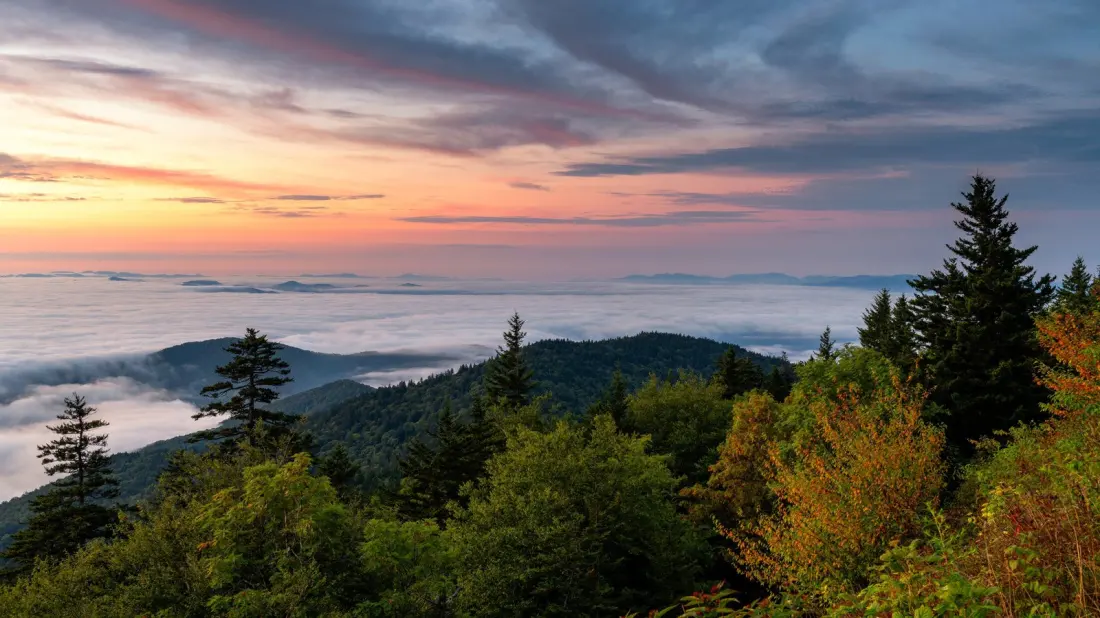
Great Smoky Mountains National Park is America's busiest — 11.5 million visits in 2025, more than double Yellowstone or Zion — and it sprawls across 522,427 acres in Tennessee and North Carolina. Even repeat visitors only scratch the surface, so advice from rangers who know the park inside out is gold. Here are the takeaways that matter most.
Wildlife watching is all about location and timing. For black bears, head to Cades Cove on the Tennessee side, where walnuts and berries draw them in. Rangers recommend driving the 11-mile Loop Road early — around 6 a.m. — or in the late afternoon, avoiding the midday heat when bears rest. Elk, meanwhile, are best spotted in the meadows of Cataloochee on the North Carolina side. Fair warning: the two spots are over three hours apart by road, so this is a park best explored over several days, not one.
You don't need to hike for a killer view. Kuwohi (formerly Clingmans Dome), the highest point in Tennessee at 6,643 feet, has a famous observation tower reached by a steep one-mile round-trip trail. But ranger Christine Hoyer points out that the parking lot itself delivers the same sweeping views — visitors regularly post sunset photos taken without walking a step. If you do want an easy walk, the Look Rock Tower trail is a gentler option at about three-quarters of a mile round trip.
If your trip falls in late May, try the synchronous fireflies at Elkmont. Thousands of rare lightning bugs blink in unison for roughly two weeks a year, and access runs through a lottery that opens about a month ahead. Entomologist Becky Nichols advises using a red-filtered flashlight (red light barely registers with the insects) — then switching it off entirely once you're settled, since artificial light disrupts their synchronized mating display.
Now the safety stuff. Black bears in the Smokies can and do open car and cabin doors, especially when they smell food. Lock everything, close windows and sunroofs, and never leave snacks inside — in 2025, Gatlinburg tourists had to break their own SUV window to free a bear that had locked itself in. Food-conditioned bears face road accidents and become more dangerous to people, so securing your food protects the animals too. And if you hit a "bear jam" — a traffic backup caused by a roadside bear sighting — rangers say enjoy it rather than honk. Just don't stop to manufacture one: in November 2025 a young bear had to be tranquilized and relocated after tourists trapped it in a jam.
Finally, two planning tricks. The park's congestion forecast uses historical data to predict parking and traffic — green circles mean clear roads, red diamonds mean packed lots — so you can pick dates or build backup plans. And leave the dog at home: pets are limited to campgrounds, roads, and picnic areas on a leash, with most trails off-limits.
For anyone plotting a first Smokies trip, these tips are the difference between a stressful drive and the kind of morning where a bear crosses the road in front of you.