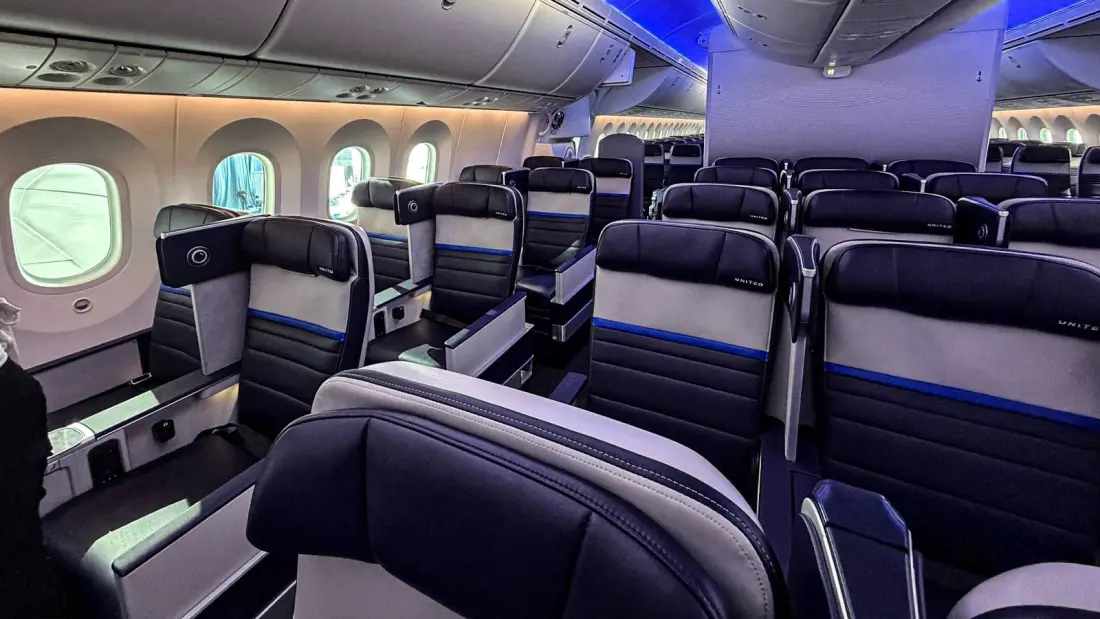
United Airlines' Boeing 777-300ERs are a neat case study in the maths of premium economy. When the aircraft arrived in 2016, they carried 366 seats: 60 Polaris business seats, 102 Economy Plus and 204 standard economy. When United installed its Premium Plus cabin, it removed four rows of Economy Plus and fitted three rows of Premium Plus in their place, dropping total capacity to 350 seats. Where 40 extra-legroom economy seats used to sit, there are now just 24 premium economy ones — a capacity cut of roughly 40% for that section of the cabin.
The tradeoff isn't just about legroom, either. Premium economy seats are wider, so airlines often lose one or two seats per row compared with economy. A Boeing 787 typically seats seven abreast in premium economy versus nine in economy; a 777 goes from ten to eight; on a 767 it's seven versus six. The exact penalty varies by aircraft — on an A380's upper deck you only lose a single seat per row.
So why do airlines keep doing it? Money. Premium economy fares often sell for around double standard economy, while the capacity hit is usually well under 50%. Airlines also report the cabin's margins per square metre now beat business class, because business seats with direct aisle access are enormously space-hungry. In the space of United's 24 Premium Plus seats, it could only have fitted 12 Polaris seats — and that's with the most space-efficient direct-aisle business seat on the market. Most rivals need 42–48 inches of pitch per row.
Demand is the other half of the story. Premium economy is still relatively new, and airlines have been conservative with cabin sizes, so supply is thin while demand keeps growing. That keeps fares high. Crucially, carriers have found premium economy buyers mostly aren't trading down from business — they're upgrading from economy, often leisure travellers on long-haul trips who want real comfort without a business-class fare.
The result: premium capacity is expanding everywhere. American's new 787-9s carry 51 Flagship Suites and 32 premium economy seats, up from 30 and 21, and its retrofitted 777-300ERs jump from 28 to 44 premium seats. United's 2026 787-9 deliveries have 64 Polaris suites and 35 Premium Plus seats versus 48 and 21 on older frames. Delta is retrofitting A350-900s with 40 Delta One suites and 40 Premium Select seats, and its A350-1000s from 2027 will have 53 and 48 respectively. Overseas, Qantas upped its A380 premium economy to 60 seats, and Air France's latest 777-300ER layout adds 16 premium economy seats.
For travellers, this all points one way: more premium economy inventory and more competitive pricing as cabins grow, but also confirmation that this is the class airlines make their best margins on. If you're flying long-haul and can stretch to it, the upgrade is worth watching for — and booking early, since supply still lags demand. (Via Simple Flying)