Some gardens you walk through. The Prieuré d'Orsan in the Loire Valley you read, like a manuscript — twelve enclosed chambers of clipped hornbeam, woven chestnut and biblical symbolism, reconstructed from medieval illustrations on a site founded in the twelfth century.
The priory's story is a turbulent one. Robert d'Arbrissel, founder of the royal abbey of Fontevraud, established the Priory of Notre-Dame d'Orsan with a chapel, mill and cloister. When he died, he split his remains between the two houses: body to Fontevraud, heart to Orsan, housed in a marble mausoleum that drew pilgrims who credited the relic with miracles. The priory prospered under generations of nuns, then weathered the Hundred Years' War only to fall in the Wars of Religion; after the French Revolution the remaining buildings were sold off and used as farm buildings.
The rescue came in the 1990s, when architects Patrice Taravella and Sonia Lesot bought the priory along with roughly forty hectares of woodland and meadow. With scholarly gardener Gilles Guillot, they imagined a priory made of plants — reviving forgotten medieval techniques like pleaching and raised wattle beds. In 2004 it was classed a Jardin Remarquable, and since 2017 English designers Gareth Casey and Cyril Pearon have carried the work on, adding new spaces with a light, nature-first touch.
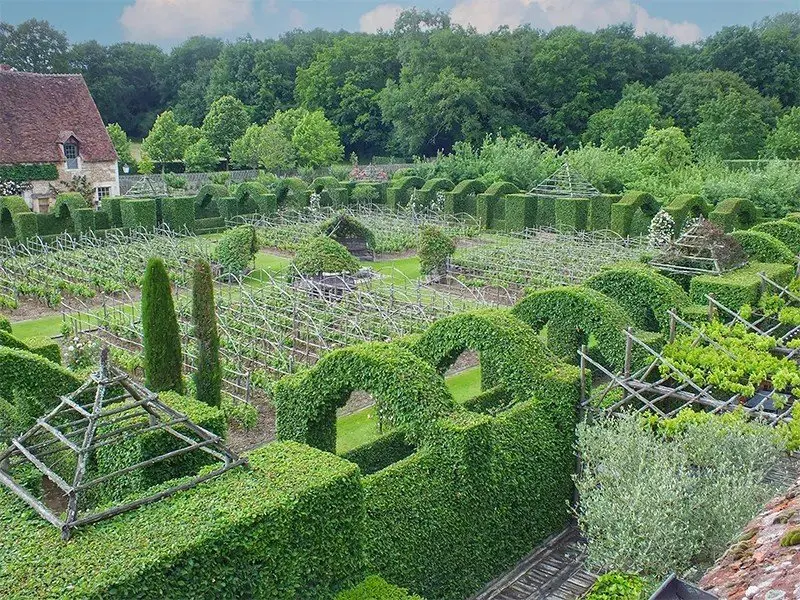
What you see today is genuinely strange and lovely. The cloister garden stands in for Eden, with a fountain whose jets represent the four rivers of Paradise and squares of vines around the spring. Then come parterres of spelt and fava beans with an olive grove — bread, wine and oil. There's a maze with a flat-topped apple tree at its centre, Mary's Gardens planted with roses, violets and lilies, a medicinal herb garden, and a working kitchen garden where artichokes and squash grow in woven raised beds beside insect-friendly flowers. No pesticides here; head gardener Thierry Joubert works by hand. Even the orchards follow a house rule: one third of the fruit for the birds, one third for visitors, one third for the owners' jam.
The real signature is the structure. Elaborate pergolas, arches and edgings built in situ from chestnut wood give the garden an airy architecture, while hedges are pierced with oval windows that frame new views at every turn. Medieval gardens were designed to be read from above — meant for God's eyes — and Orsan still rewards that aerial geometry, though ground-level strolling is equally beautiful.
Practically, a visit comes with extras: a tearoom serving lunches and teas, and a shop selling gardening tools, bird boxes, fresh juices and homemade jams. It fits neatly into any Loire Valley itinerary — you could pair it with the châteaux of the region or Fontevraud Abbey, its spiritual sibling an hour or so away. For gardeners, designers, or anyone who enjoys history you can touch, Orsan is one of the most original hours in France. It also features in Stéphane Marie's A Garden Tour of France (Flammarion, 2026), which profiles 27 gardens open to the public nationwide.