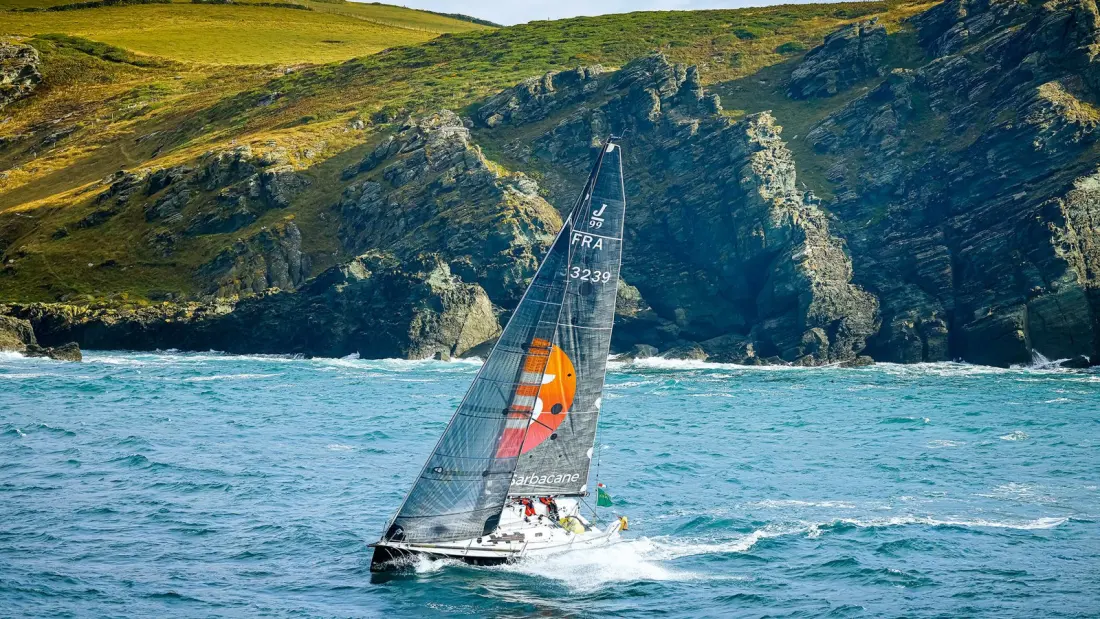
Every dinghy sailor knows the ritual: hot morning, flat sea, and the hopeful question of whether the sea breeze will fill in. A piece by forecaster Simon Rowell in Yachting World breaks down a tool that makes that guesswork a lot smarter — Quadrant Theory, developed by David Houghton and Fiona Campbell, the forecasters behind Olympic and America's Cup campaigns.
The idea is simple once you see it. Stand looking at the shore and note where the gradient wind — the big-picture wind aloft, best spotted by watching low clouds — is coming from. On your port bow it's Quadrant 1, starboard bow Q2, port quarter Q3, starboard quarter Q4. Each quadrant produces a completely different afternoon on the water.
Offshore gradients are the good news. A Q1 wind, where friction drops as the air moves from land to water, creates divergence near the coast. That sinking air helps the sea breeze cell spin up, and the result is usually a stronger breeze that lasts longer, settling 20-40 degrees off the shoreline. Q2 is the awkward cousin: the wind curves shoreward instead, creating convergence along the coast. The sea breeze is slower to form, weaker, and often parks itself offshore without ever reaching the beach. Rowell's tip: watch where the chop dies away — that invisible line is where your breeze gives up.
Onshore winds are tougher. A sea breeze cell has to fight the gradient wind aloft, so it only develops in light conditions, often after a complete lull. More common is thermal modification. A Q3 wind can get a boost around 1400 local time — Rowell has seen it jump 12 to 18 knots and veer 20-30 degrees in about half an hour, thanks to land heating, falling pressure and Buys-Ballot's law doing their thing. Q4 is the one the British Sailing Team calls "thermal disenchantment": the pressure gradient collapses and the afternoon turns light, patchy and frustrating, with random local effects — a hot car park or airport tarmac near the beach — throwing in their own micro-breezes. The advice there is blunt: stay offshore, where the wind is steadier.
Why should a holiday sailor care? Because reading the gradient wind over breakfast tells you whether the afternoon race, the dinghy hire slot or the coastal sail is worth rushing for. It also works in reverse — knowing a Q3 enhancement kicks in around 2pm means you can time a swim or lunch for the lull and sail when it's good. Few coasts are straight lines of sand with clean sea breezes, but as a rough rule of thumb, quadrant theory beats hoping.