Two days before officially starting the Camino de Santiago, a walker and his old friend Rosanne set out on a warm-up hike through rain-soaked Spanish countryside — and found themselves having a much bigger conversation than the one about blisters and gear.
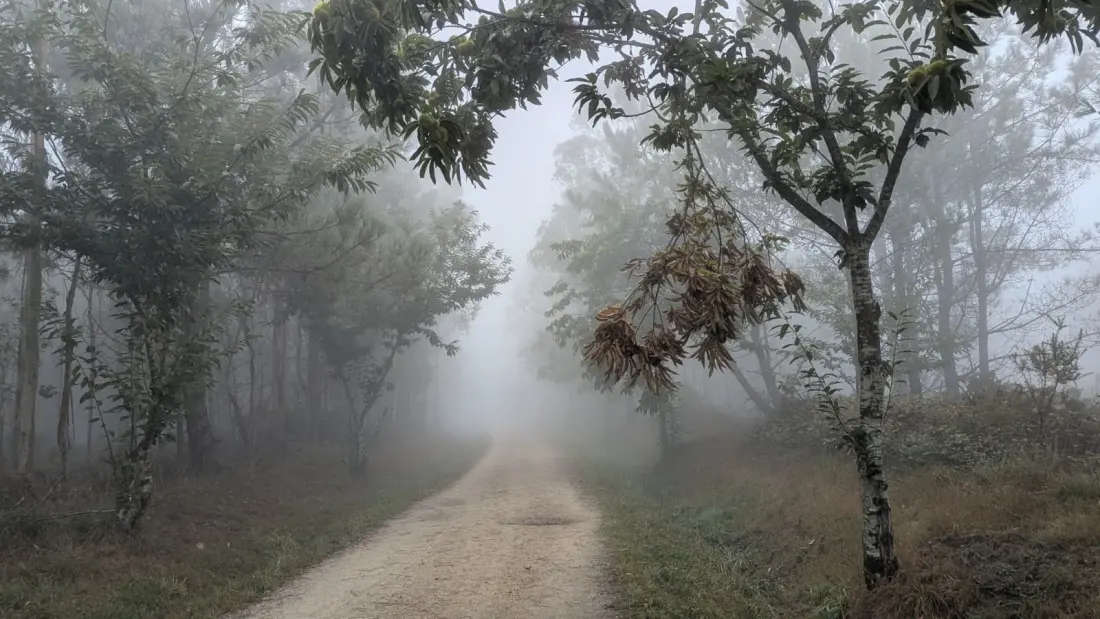
The route follows a quiet, tree-lined lane between farm fields, the kind of track where visibility in the cloud drops to about ten steps ahead. Navigation here means the Buen Camino app rather than local knowledge; only the farmers know whose fields these are or what's growing in them. The pair leave before first light with headlamps on, walking through dripping tree tunnels while the rain pours off the branches — getting moving before the cows do.
The path itself carries serious history. Sections run over original Roman roads, with chariot ruts still visible worn into the cobblestones. Long before it became a Christian pilgrimage, this route is thought to have been laid out by the Celts and later adapted by the Romans — possibly a cosmological journey to what was believed to be the end of the earth, where pilgrims could watch the sun sink into the Atlantic each night. That's a 3,000-year-old walking tradition under your boots, even if most modern pilgrims barely register it.
One thing that has genuinely changed since this walker's last Camino: registration. Spain now requires pilgrims to submit passport numbers, phone numbers and email addresses, and each albergue (pilgrim hostel) handles it differently. Some send a digital link in advance, others take details on a phone, and one night involved typing everything into a battered innkeeper's iPad — which promptly crashed after a large, energetic group of Italians had already exhausted her. A service called Pilgrim Pass consolidates the data into a QR code, but at the end of a long, wet walking day, the paperwork ritual remains the least loved part of the experience.
The deeper thread of the story is what gets discussed between rain showers: life after work. Rosanne spent 30 years as the writer's chiropractor before retiring two years ago, and became a family friend along the way — Thanksgiving dinners, a daughter's wedding, regular Thai food nights. Now she faces the same question as many newly retired travellers: what fills the space a career leaves behind? Her old passion, a sailboat, is up for sale with nothing yet to replace it. Her walking companion has already found his answer in backpacking. The exercise they land on is simple and worth stealing: each writes a list of ten things to do — some brave, some familiar, some long postponed — and starts testing whether any of them delivers a sense of purpose.
For anyone considering the Camino, this is a useful, honest snapshot of what the early days actually look like: grey skies, wet gear, clunky hostel check-ins, and long hours of conversation with whoever you're walking beside. It's less a sightseeing trip than a walking rhythm — and increasingly, a rite of passage for people navigating life transitions. Bring rain gear, download your apps in advance, and maybe bring a list of ten things of your own.