Black volcanic sand doesn't sound like much of a dive site. No coral walls, no postcard reefs – just a grey-brown seabed that looks, at first glance, empty. Yet the Lembeh Strait in North Sulawesi, Indonesia, sits inside the Coral Triangle and hides one of the densest concentrations of rare critters in the ocean: pygmy seahorse camouflaged on gorgonians, flamboyant cuttlefish flashing colour, blue-ringed octopus, coconut octopus carrying their shell homes, ribbon eels and ghost pipefish.
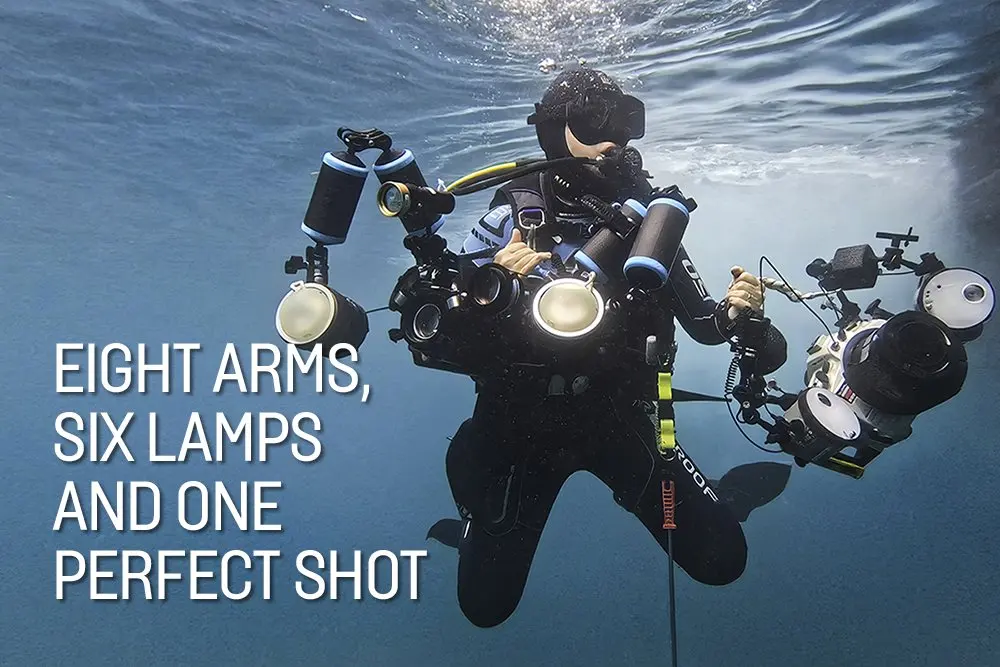
Award-winning underwater photographer Nur Tucker calls it an annual pilgrimage, and her recent work there shows why the strait has become a magnet for macro enthusiasts. She also shows what it takes to get the shot. Her toolkit runs from narrow-beam torches (a 5–10 degree spotlight you use to paint light onto a single eye or tentacle) to snoots, cross-lighting setups, 'kisses of light' – dialling strobes down until darkness becomes part of the frame – and even vintage film-era lenses like the Helios 44 and Trioplan 100mm for swirly, painterly bokeh. One image, of a thorny seahorse, is an in-camera double exposure blending a backlit silhouette with sunlight shot through the water at 10 metres. Some subjects took two full 60-minute dives just to face the camera.
Her practical advice is refreshingly gear-agnostic. Macro photography, she argues, is really about problem-solving in three dimensions: managing buoyancy, watching the animal's behaviour, and moving lights millimetre by millimetre – all while avoiding stonefish and never disturbing the subject. Diving with a good centre matters enormously here. Tucker works with Critters at Lembeh, whose guides (she name-checks Opo K, Sandro, Jendry and Vardy) spot creatures most divers would swim straight past and act as extra hands when she's juggling torches and strobes.
For travellers, the takeaway is that Lembeh rewards a different kind of diving. There's little to see on the reef itself; the magic is in slowing down, going with a sharp-eyed guide, and looking at what looks like nothing. It suits divers with decent buoyancy control and patience, photographers willing to fail repeatedly for the occasional perfect frame, and anyone curious about animals that feel genuinely surreal. Pair it with nearby Bunaken for walls and bigger fish, and you get two completely different Indonesian dive trips in one region.