
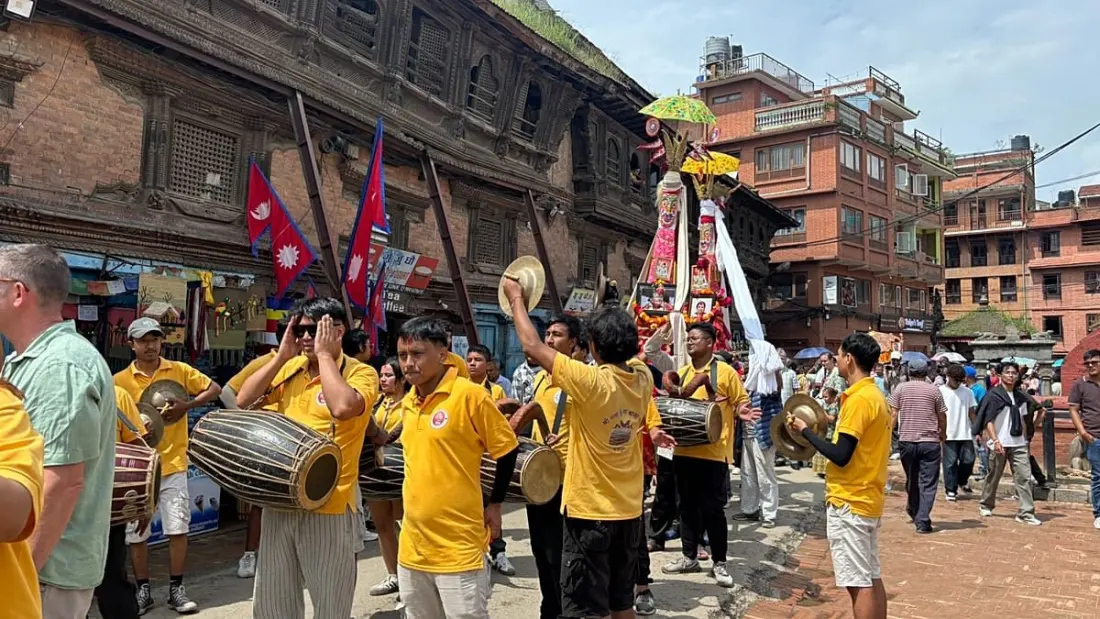
Most cultures say goodbye to the dead in silence. In Nepal's Kathmandu Valley, the Newar people do it with drums, dancing and a street procession that turns grief into something closer to a carnival.
Sa: Paru, also known as Gai Jatra, is held after the August or September full moon and honours everyone who died in the past year. Each household that lost a family member builds a taha: sa — a decorated bamboo structure topped with a painted portrait of a sacred cow, once the real animal in the procession. Red wrapping marks a woman who has died, white a man, and the finished piece carries a photo of the deceased, images of Shiva and an umbrella for shade — a mark of respect. Neighbours help build them whether they're bereaved or not. As one local put it, the rituals simply aren't possible without the wider community.
On festival morning, the taha: sa wind through the streets with music, bells and the Ghintang Ghisi dance, where pairs clash sticks in rhythm. Groups start at their own pace — some so fast the structures sway like a drunken cow — before the crowded streets force everyone into one slow, shared procession. Dress code? Whatever you like: traditional wear sits alongside football kits and Hawaiian shirts. Visitors are welcome to join in, and as one Nepali who flew back from the US for it said, the best way to learn is to get involved.
The details are fascinating. The festival's satirical edge is credited to King Pratap Malla, who expanded it in the 17th century to cheer his wife after their son's death — today that means masks mocking politicians like Donald Trump and Vladimir Putin. Historians trace the tradition back to the 14th century. And while most of the valley celebrates for a day, Bhaktapur keeps going for eight, with dance performances across the city.
That's a good reason to stay longer. Most tourists treat Bhaktapur as a brief detour from Kathmandu, an hour at Durbar Square and the 55 Window Palace before heading back. But the city rewards slow travel: ceramics drying at Pottery Square, hands-on pottery workshops, and the Peacock Shop, where the owner walks you through traditional Lokta paper making. Boutique hotel The Nanee, founded by a local family, runs experiences with residents — a morning walk with a housewife, dinner with an artisan — to keep tourism money in the community.
One practical note: recent flash floods near the Tibet border killed more than 1,300 people and prompted some travellers to cancel trips. But the main tourist areas — Kathmandu Valley, Everest and the trekking trails — were unaffected, and tourism income matters more than ever right now.
Who's this for? Anyone who wants festivals that mean something, not just spectacle. Sa: Paru isn't celebrating death, as one local priest explained — it's celebrating a soul moving towards salvation. That's a farewell worth travelling for.