
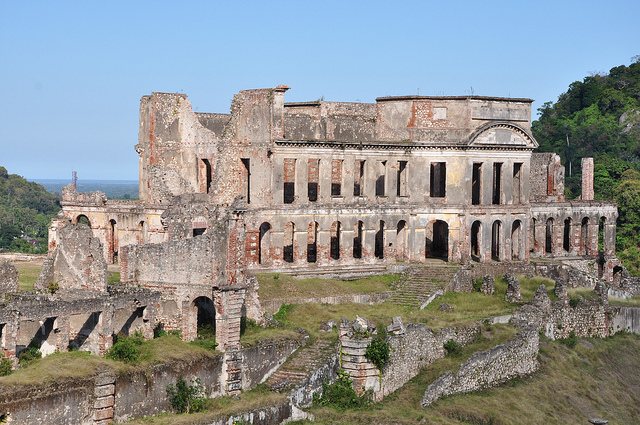
High in the hills near the northern Haitian town of Milot stand the immense ruins of Sans-Souci, the palace built by Henri Christophe, the former slave who crowned himself King of Haiti in 1811. Its name means 'carefree' in French, which is an irony the building wears heavily: labourers died in numbers no one ever counted to raise it, and its royal builder ended up shooting himself through the heart with a silver bullet.
Christophe's path to the throne was unlikely. Born free in Grenada and enslaved as a child in Saint-Domingue, he may have served as a drummer boy with the French at the Siege of Savannah during the American Revolution, picking up a working knowledge of how European courts operated. Back in Haiti he worked as a mason, sailor and plantation manager before joining the 1791 slave uprising, rising to general under Toussaint Louverture. After Emperor Jean-Jacques Dessalines was assassinated in 1806 — a plot Christophe knew about and did nothing to stop — he was elected president with little real power, retreated north, and declared a kingdom of his own. His coronation by the Archbishop of Milot followed in 1811.
Construction of Sans-Souci began almost immediately and, remarkably, the vast palace was finished in just two years, opening in 1813. It was propaganda in stone, a deliberate rival to Versailles meant to prove that a free black nation could match the pomp of Europe. Underground pumping systems fed artificial springs and fountains across enormous gardens, and grand feasts and balls became regular fixtures. European guests wrote admiringly of the place, even as their home papers mocked Christophe's invented princes and dukes — a snobbery that stung a king whose country was, after the United States, only the second in the Americas to break free of colonial rule before 1800.
It didn't last. Facing a coup and revolt in the south, Christophe killed himself in 1820. Ten days later his nephew and heir, Prince Jacques-Victor Henry, was bayoneted to death at the palace itself. Haiti reunified the following year, and Sans-Souci stood intact until a massive earthquake in 1842 left it the shell visitors see today. The family's grip on Haitian history stretched oddly far forward, though: Christophe's great-great-great-granddaughter Michèle Bennett was First Lady as the wife of Jean-Claude 'Baby Doc' Duvalier until their regime collapsed in 1986.
For travellers, Sans-Souci is one of the Caribbean's great under-visited historic sites — a UNESCO World Heritage setting alongside the nearby Citadelle Laferrière, Christophe's mountain fortress just above Milot. Both are usually reached from Cap-Haïtien, and visiting pairs well with the city's colonial old town. Go for the history: few places in the Americas compress a revolution, a monarchy and a dynasty's collapse into one hillside.