
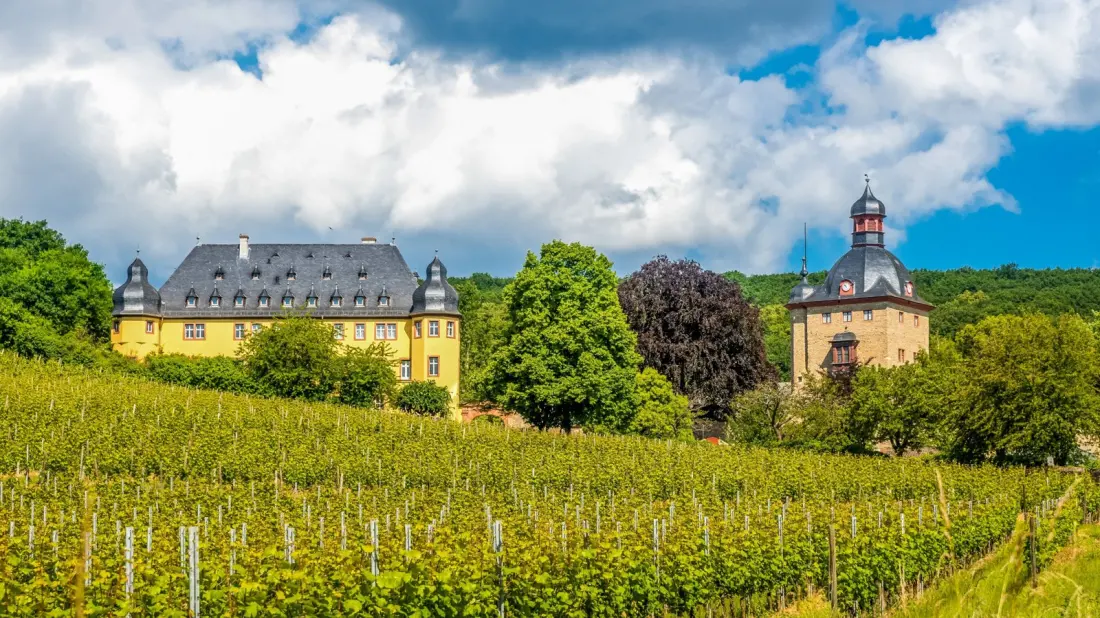
Winemaking goes back roughly 8,000 years — the earliest evidence points to ancient vineyards in Georgia — but a handful of European estates have been pouring for well over a millennium, and they're all open to visitors today.
The oldest of the lot is Nikolaihof in Austria's Wachau Valley, with roots tracing to 777. It began life as a Roman army base where soldiers, entitled to the equivalent of three bottles a day, planted their own vines. Now run by the Saahs family, it works nearly 55 acres organically and biodynamically, growing grüner veltliner, riesling and chardonnay, and ageing wines in Austrian oak for a dozen years or more. Tastings run Fridays and Saturdays only.
Germany claims three entries. Schloss Johannisberg in Geisenheim, first recorded in 817, became the world's first riesling-only estate in 1720 and was named Europe's best winery in 2025. Visitors can taste in a 25,000-bottle abbey cellar or outside with views over the Rheingau. Staffelter Hof in the Mosel, founded by Benedictine monks in 862, hand-bottles unfiltered wines and even offers a candlelit cellar tasting with sound bowls from about $23. Schloss Vollrads in Oestrich-Winkel has sold wine commercially since 1211, making it one of the longest continuously operating wineries anywhere; it sticks to riesling across more than 170 acres and pairs tastings with an on-site restaurant.
In France, Château de Goulaine near Nantes has been in the Goulaine family since 1000 — briefly lost in 1788, bought back in 1858 — and doubles as a museum and event venue, pouring a chinon, a rosé and a sauvignon blanc. Italy's Ricasoli 1141 at Brolio Castle in Chianti invented the Chianti Classico formula in 1872 and now farms over 345 acres, offering sunset tastings from about $46 up to private tours with lunch around $197.
Further east, Croatia's Kutjevo in Slavonia still uses a cellar built by Cistercian monks in 1232, and its wines account for half of all Croatian wine exports; tours cost $17–$21. Slovenia's Ptujska Klet, dating to 1239, is the country's oldest continuously running winery and guards the century-old Zlata trta, its most storied preserved wine. And in Catalonia, Codorníu — Spain's oldest family business, from 1551 — created cava in 1872.
Why it matters: these aren't museums. Every one of them is rated at least 4.4 stars on Google, and most offer tastings for under $25, making them an easy, affordable anchor for a wine-country trip across Austria, Germany, France, Italy, the Balkans or Spain.