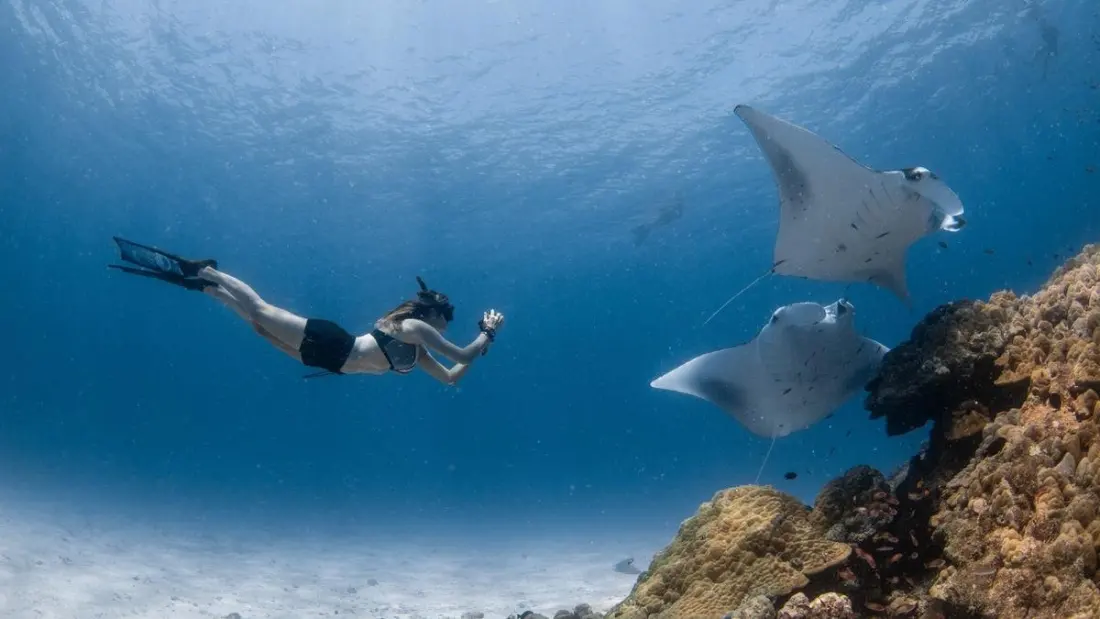
A phone that rings when manta rays are nearby sounds like a gimmick, until you're on a speedboat 20 minutes later, fins on, watching a five-metre ray barrel-feed through a bay full of plankton. That's the idea behind 'Manta on Call' at the Four Seasons Resort Maldives at Landaa Giraavaru, a 44-acre private island in Baa Atoll. Guests get a resort-issued phone that may ring between 9am and 6pm whenever researchers spot mantas, and a trip to Hanifaru Bay, one of the world's key manta aggregation sites, follows. The Maldives holds the largest reef manta population on earth and the third-largest oceanic manta population, so the odds are good.
The island itself has an odd backstory. Just two decades ago it was a coconut plantation that local families visited by boat to harvest and trade the crop. One employee, Ali Suaidh, remembers coming here as a child with his grandfather and 26 cousins. The Four Seasons opened in 2006, and Landaa Giraavaru — which means 'moving sand' — is now a protected island inside a UNESCO World Biosphere Reserve.
What sets the resort apart from the standard overwater-villa operation is the Marine Discovery Centre, a working research hub run with marine biologists. It houses a fish lab, a turtle rehabilitation centre, a coral restoration programme with Maldivian consultancy Reefscapers, and the Maldives Manta Conservation Programme, which marks its 20th anniversary this year and is where the Manta Trust — now 30 affiliated projects worldwide — first began. Beyond the on-call alerts, guests can join manta safaris, private trips and Friday interactive talks with quizzes. Teenagers aged 13 to 18 can sign up for a Trainee Marine Biologist Programme covering everything from corals to dolphins, and anyone can symbolically adopt a manta and name it. A new manta-tracking website and a free AR/VR learning app called Manta Story are launching this August.
The conservation ethic runs through the back of house too. The resort runs largely on solar power (since 2017, with floating panels now on trial), recycles all landscaping waste, composts 30% of food waste, and is fully self-sufficient in microgreens, oyster mushrooms and herbs like mint, basil and lemongrass grown on-site. It produces its own bottled drinking water — around 1,200 bottles a day for guests. Even the staff cafe has a story: it's named after Umabe, a local islander who taught the original team about the island's vegetation and how to build without wrecking its ecological balance.
For travellers, this is the rare luxury resort where a marine biology session competes with the spa. It suits families with teens who'd rather learn to ID manta flanks than lounge by a pool, couples who want a serious snorkel fix, and anyone who likes their five stars with a side of reef science. Bring reef-safe sunscreen and an appetite for early boat calls — that phone could ring at any time.