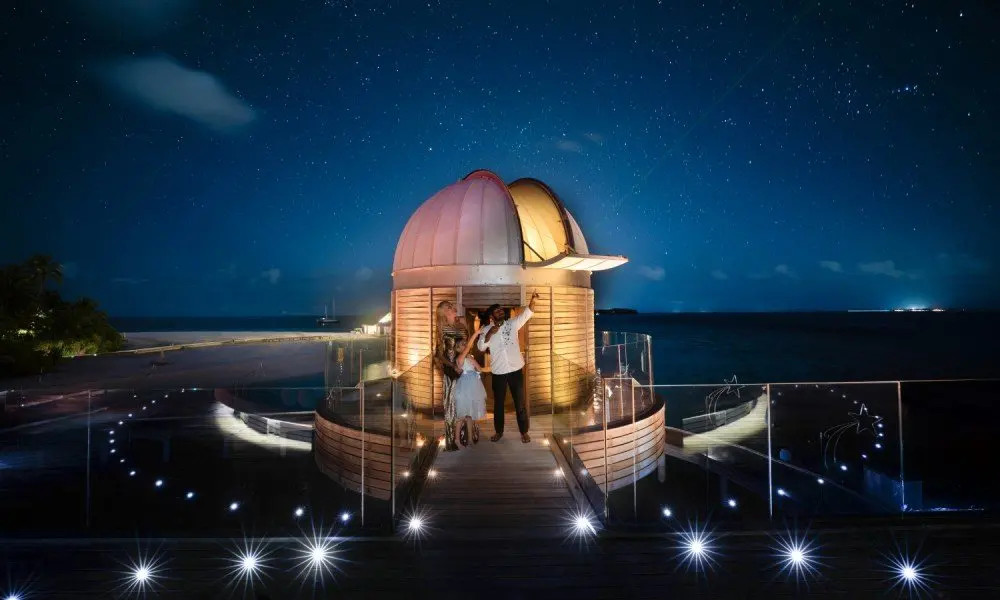
Most people come to the Maldives for what's under the water. At Anantara Kihavah Maldives Villas, there's a growing case for looking up instead. The resort's private island sits inside the Baa Atoll UNESCO Biosphere Reserve, where darkness at night is the norm rather than the exception — and the hotel has built an entire stargazing programme around it.
The stars of that programme (literally) are two resident astronomers known as SKY Edhurus — 'edhuru' is Dhivehi for teacher. Ali Arushal, or Shalli, and Sajidha, or Saji, run sessions from a dome-like observatory that houses what's described as the most powerful telescope in the Maldives. On any given night, guests might be shown Saturn's rings or a dense globular cluster of ancient stars.
The location matters as much as the equipment. Because the Maldives sits close to the equator, visitors get a sky that most of Europe and North America never sees: constellations and planets that hug the horizon elsewhere rise high and clear here, visible across both the northern and southern celestial hemispheres. Add the near-total absence of light pollution over open ocean, and you have one of the most reliable stargazing settings in the tropics.
The human stories are part of the draw. Shalli started out on the island's boat crew, ferrying guests across the lagoon before astronomy hooked him — his first sighting through the telescope was Omega Centauri, a vast ball of millions of ancient stars. Saji, the resort's first female SKY Edhuru, was converted by a meteor shower over the lagoon, and now specialises in steadying guests who feel small under the scale of the sky.
The resort timed its spotlight on the pair around International Astronomy Day on 19 September, framing it as part of a wider push to protect dark skies — a natural resource that's quietly disappearing in much of the world.
Why should this be on your radar? It's a rare holiday add-on that costs you nothing but a clear night. Snorkelling and diving fill your days; the observatory fills the hours after dinner, and many guests find it as memorable as the manta rays. It's a natural fit for families (kids tend to love the telescope), couples after a low-key evening, and anyone who's only ever seen a washed-out suburban sky. If you're booking a high-end Maldives trip and comparing islands, an actual observatory with resident astronomers is a genuine point of difference — few resorts anywhere offer it.
One practical note: timing is everything. New-moon weeks give you the darkest skies and the best views of clusters and faint constellations, while full moon nights favour bright planets and easy moon viewing. Either way, the equatorial sky delivers something different from what you'd see at home — which is arguably the point of going.
The astronomy programme also folds into a broader moment for Anantara, which is marking its 25th anniversary this year with a series of guest experiences across its portfolio. Source: Maldives Insider.