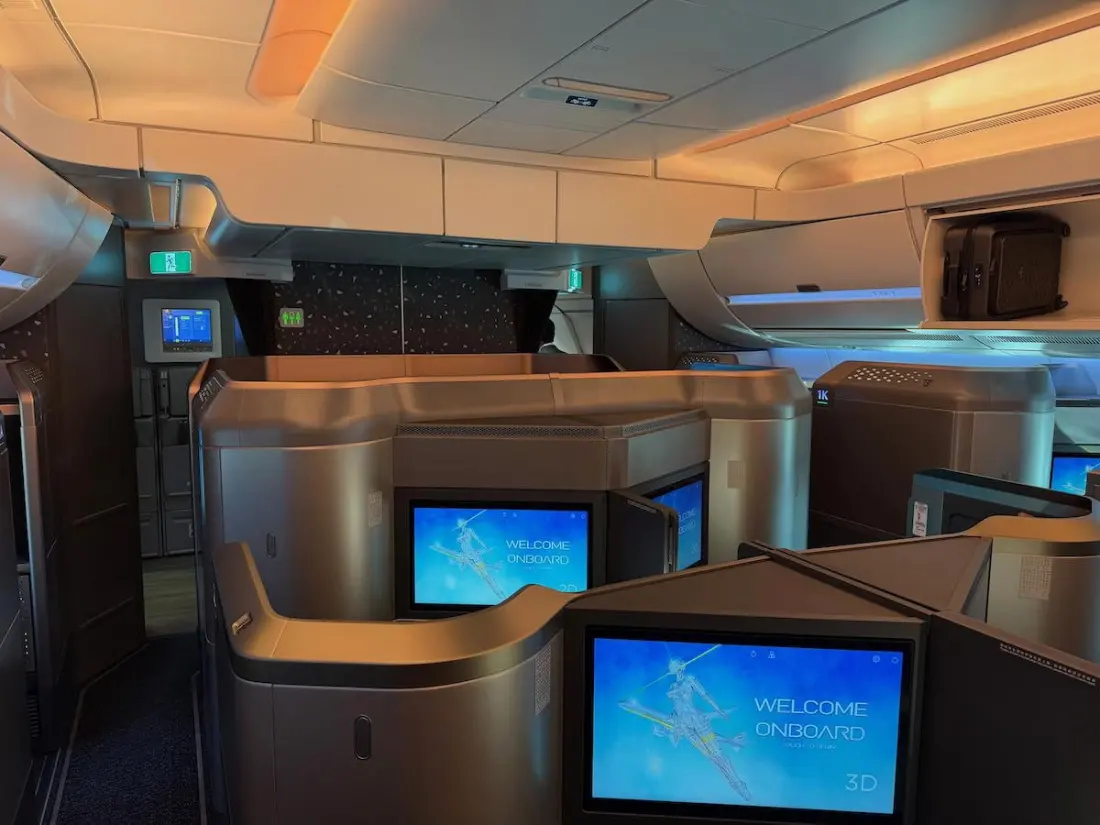
International first class on a flight under three hours is almost unheard of these days, which is what makes Starlux Airlines' Taipei-to-Tokyo Narita route such a curiosity. The Taiwanese carrier regularly flies its biggest Airbus A350-1000 on this 2hr55min hop, and one frequent flyer recently reviewed the experience, having flown the airline's A350-900 from Los Angeles the day before on the same ticket.
The hard product is genuinely impressive for a short flight. First class has just four seats in a 1-2-1 layout, each with 83 inches of pitch and width of 23 inches, converting into an 83-inch flat bed with a 32-inch TV and imposing 60-inch privacy walls. Business class, in comparison, offers 44 inches of pitch and 24-inch screens. There's no curtain or bulkhead between the two cabins, so it reads a bit like "business plus," but the crew apparently do a good job protecting the first class bubble — including guarding the forward lavatory for first class passengers only.
What Starlux doesn't water down is the catering. Despite the early morning departure, the reviewer pre-ordered a lunch-style meal through the airline's pre-order program: a Japanese appetizer, a salt-baked truffle wagyu steak from the HUTONG collaboration, and dessert of amazake panna cotta. The champagne was Bollinger La Grande Année 2015, and the wine list even includes Taiwanese producers — a Weightstone Gris de Noirs sparkling rosé got high marks, following a memorable lychee-scented Weightstone white on the earlier flight. A boba latte before landing rounded things off. Amenity kits and pajamas are reserved for long-haul flights, but this segment still came with a Loro Piana blanket, a leather pillow, Yu Chocolatier chocolates, slippers, and a choice of watermelon or sparkling peach juice as the pre-departure drink — Starlux serves no alcohol on the ground at any airport.
The booking mechanics are worth knowing. The whole two-segment first class itinerary cost 120,000 Starlux COSMILE miles plus about $306 in taxes and surcharges — but since COSMILE miles are hard to earn, the reviewer bought them outright, putting roughly $5,000 into the ticket. Starlux miles don't transfer widely from bank points, so this is a splurge either way you slice it.
Perhaps the oddest detail: the flight was nearly empty. One passenger in first, around five in business, and a second A350-1000 flying the same route a couple of hours apart. Starlux essentially parks its widebodies on the Taipei–Tokyo run between long-haul rotations, so the opportunity cost is low — and for anyone who can book or upgrade, it's a remarkably generous way to cover one of Asia's busiest city pairs. Viasat Wi-Fi is free, the crew-to-passenger ratio on this flight was two to one, and the reviewer rates the service as close to flawless. If you've ever wanted to try first class without committing to a 14-hour flight, this three-hour hop might be the easiest entry point out there.