
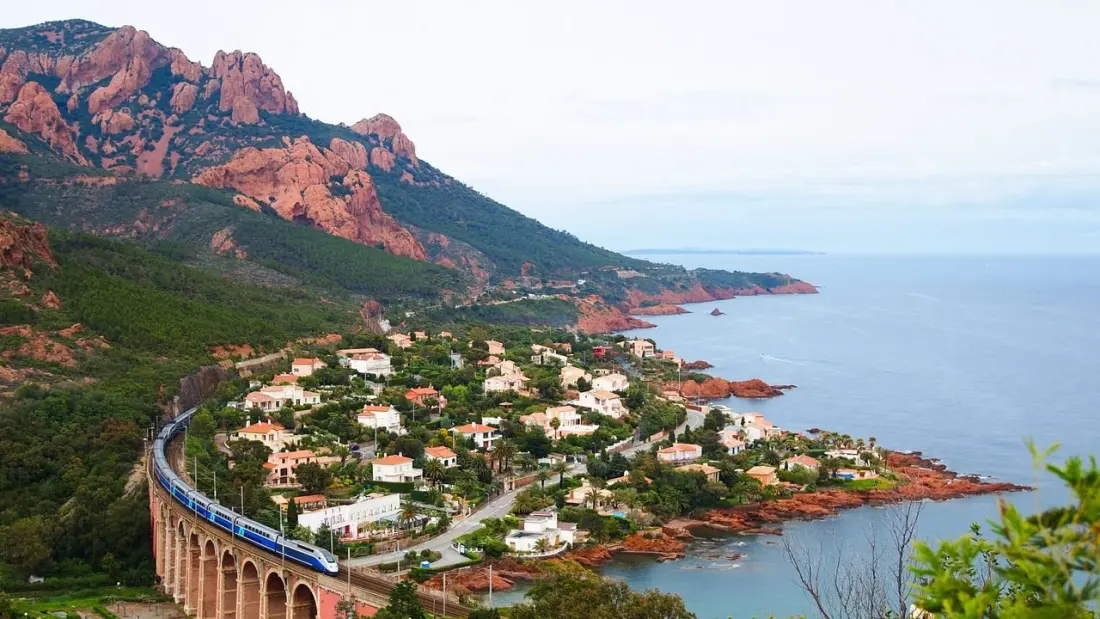
Fast trains have quietly become one of the best reasons to skip the airport. There are now roughly 56,000km of high-speed lines worldwide, built for speeds of at least 250km/h, and more than three billion passengers ride them every year, according to the UIC. Here are the trains worth planning a trip around.
Japan's Shinkansen is the icon. The original Tōkaidō line launched before the 1964 Tokyo Olympics and still carries over 160 million passengers a year between Tokyo, Yokohama, Nagoya and Osaka, with trains hitting 320km/h and peak departures every three minutes. Splurge on Gran Class for reclining 45-degree seats and proper hospitality.
China holds the speed crown. The Shanghai Maglev levitates between Pudong Airport and Longyang Road in about eight minutes, with an operational top speed of 431km/h (cruising capped at 300km/h as of 2026). The CR400AF 'Fuxing' reaches 420km/h and includes a 16-carriage sleeper running between Beijing/Shanghai and Hong Kong West Kowloon.
Europe offers plenty of choice. Eurostar has linked London and Paris since 1994 and now serves five countries including the Netherlands, Germany and Switzerland — slower than flying door to door is not, thanks to city-centre arrivals and no airport transfers. France's TGV has been running since 1981 and tops 320km/h on its fastest lines, connecting Paris to Lyon, Marseille, Bordeaux and Lille. Germany's ICE3, in service since 2000, cruises around 330km/h, while Spain's AVE S-103 links Madrid, Barcelona, Zaragoza and Tarragona, and Italy's Frecciarossa 1000 runs from Turin and Milan down to Naples — with some services extending into France and Spain beyond.
Further afield, Morocco's Al Boraq has connected Tangier and Casablanca in about two hours since 2018 — the first high-speed line in Africa and a serious alternative to domestic flights. In the US, the revamped Acela, rolled out in 2025, can hit 320km/h on upgraded sections of the Boston–Washington corridor. South Korea's KTX-Cheongryong also runs at around 320km/h, using distributed traction — motors spread through the train — for quicker acceleration.
For anyone weighing train versus plane, the case keeps improving: shorter check-ins, city-centre stations, a far smaller carbon footprint, and scenery you actually get to see. Business travellers lean on Eurostar Premier for lounges and priority lanes; holidaymakers can use these networks as the spine of an itinerary, whether that's an overnight sleeper to Hong Kong or a week hopping between Italian cities. Rail passes and advance bookings (via operators like smart-ex.jp, sncf-connect.com or renfe.com) bring costs down sharply if you plan ahead. Whoever said getting there is half the fun never rode at 430km/h.