
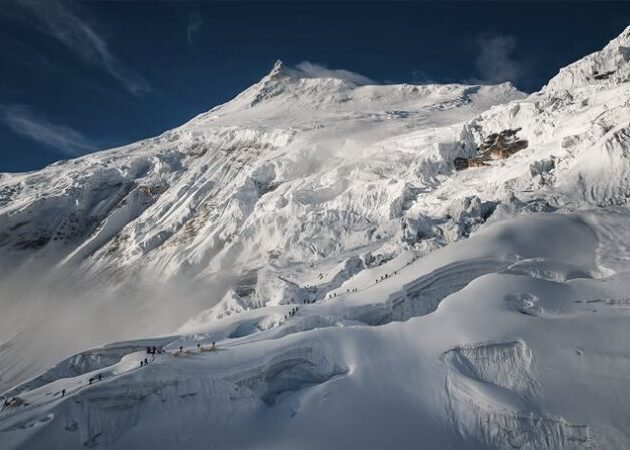
Nepal's eighth-highest peak is busier than it has ever been this autumn — and the clock is ticking. Rope fixers reached the 8,163m summit of Manaslu late Wednesday night, at 9:25pm local time, opening the route for a rush of climbers who now have just days to get up and down before a cyclone churns toward the Nepal Himalaya.
The stakes were clear from the start. A day earlier, an avalanche wiped out part of the fixed route, forcing four extra Sherpas to hustle 1,300m of fresh rope up the mountain. Led by Chhiring Bhote, the fixing team worked nonstop through the day to finish the job in darkness. Guide Abiral Rai, speaking from Base Camp, said pressure to fix the lines early came straight from the grim forecast.
The numbers tell the story of a mountain under strain. Nepal's Department of Tourism lists 493 foreign climbers on permits, and with almost everyone accompanied by one or two Sherpas — plus the gear, food and oxygen they carry — more than 1,000 people are on the mountain. Bottlenecks are inevitable, especially in the serac zone between Camps 1 and 2 and on the narrow snowy ridge to the true summit, which fits only one or two climbers at a time.
In a normal season, teams would stagger their pushes: some rushing the summit early, others waiting for calmer slopes. The weather has removed that option. Most teams are targeting Sunday through Wednesday as summit days, and many climbers will go straight from their acclimatisation rotation with no rest days in between. Forecasts are muddled — Nepal's meteorology department has announced snow in the Central Himalaya through the weekend, with a possible break Monday to Wednesday, then heavy snow from Thursday as a Bay of Bengal cyclone arrives. The monsoon's westerly winds, sitting further south than usual, are already dumping snow at Camp 2 and rain-turned-snow at Base Camp.
There are also early warnings of trouble on the mountain. Unconfirmed reports circulated of a climber falling, and a helicopter was filmed rescuing someone from Camp 2. This follows the death of a Singaporean climber above Camp 2 from apparent altitude sickness.
For anyone who follows Himalayan climbing — or dreams of an 8,000er themselves — this is a real-time lesson in how weather windows, crowding and compressed schedules shape modern high-altitude mountaineering. The rise of guided commercial expeditions on Manaslu, once a quieter alternative to Everest, is also worth noting: a mountain with a thousand people on it behaves very differently from a mountain with fifty. If you're considering a peak like Manaslu, the takeaway is that timing, operator choice and honest fitness assessments matter more than the summit photo.