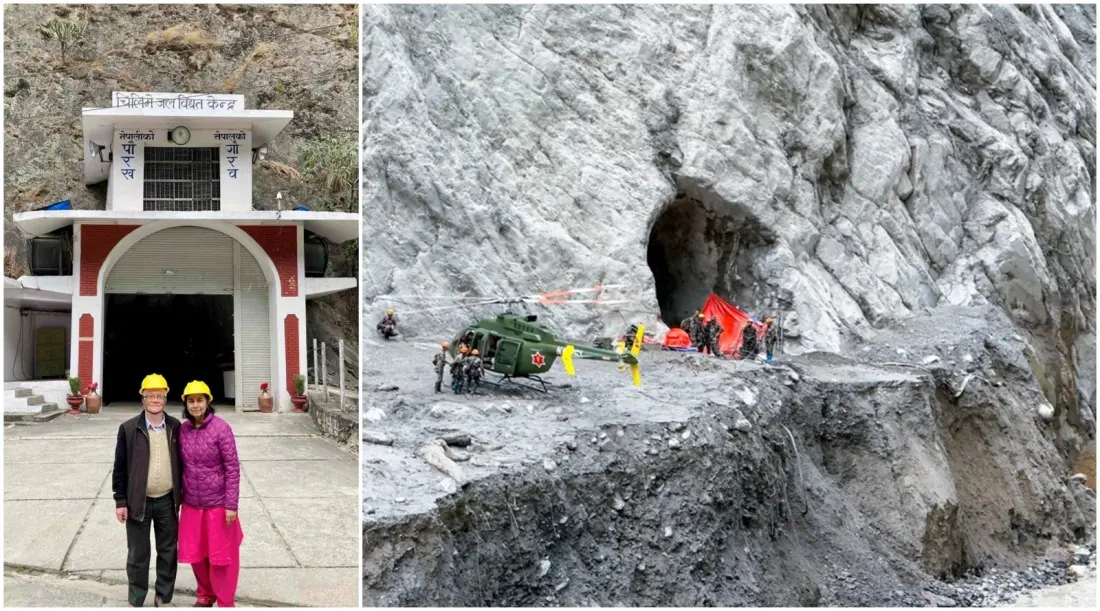
On 26 August, a flood surged through the Trisuli basin in central Nepal and wiped out around a dozen hydropower projects in a single day. Among them was Chilime, a 22.1MW plant on the Bhote Kosi that had been feeding electricity into the national grid since 2003. Its powerhouse now sits buried in mud, six people died, and hundreds are feared dead across the affected sites.
For most of Nepal, this was an infrastructure story. For Dristy Shrestha, writing in Nepali Times, it was family history. Her father, Damber Bahadur Nepali, spent roughly a decade building Chilime — a project designed, financed and constructed entirely by Nepalis, without the international loans and grants that usually underwrote such schemes. At the family dinner table, the children heard about monsoon landslides, ministers requisitioning project jeeps, complaints to the anti-corruption commission, and the endless rounds of government offices needed to keep work moving.
Chilime mattered beyond its output. It proved that Nepali engineers and institutions could deliver a major power plant on their own, and it changed who got to invest in hydropower. Ten percent of shares were set aside for local communities, and Shrestha's father personally brokered a deal letting Nepal Electricity Authority staff buy in using provident fund savings — pulling ordinary households into the stock market for the first time. The project's public-private model, with the NEA in the majority, local ownership guaranteed and private investors alongside, shaped a generation of schemes that followed, including the far larger 456MW Upper Tamakosi. Her father called that one "Chilime's elder brother".
The flood has now forced a harder question: can hydropower still anchor Nepal's development when the climate crisis makes glacial lakes and extreme rainfall such an obvious threat to everything built along the rivers? Shrestha argues the country cannot afford to abandon the sector — projects can be repaired and new tunnels dug — but that rebuilding demands the same integrity and persistence the original Chilime team showed, not just concrete.
For travellers, the story is a window into the Trisuli valley itself: the road corridor between Kathmandu and the Langtang region, popular for white-water rafting on the Trisuli river, runs through exactly the terrain these disasters reshape. The landslide and flood risk that has always shaped life here is now more visible than ever, and visitors heading into Nepal's middle hills should expect disrupted routes and check local conditions in the post-monsoon period. Nepal's schoolbooks long claimed the country had the world's second-greatest hydropower potential after Brazil — a ranking that was never accurate — but standing in the valley, watching what one night of water can undo, you understand why the promise, true or not, has defined modern Nepal.
The deepest point in Shrestha's essay is that Chilime's real legacy was never the powerhouse itself. It was the proof that a small, underfunded team could start with an idea scribbled in a shirt-pocket notebook and end up with a four-storey machine hall carved inside a mountain. That is the part, she writes, no flood can wash away.
Original story: Nepali Times