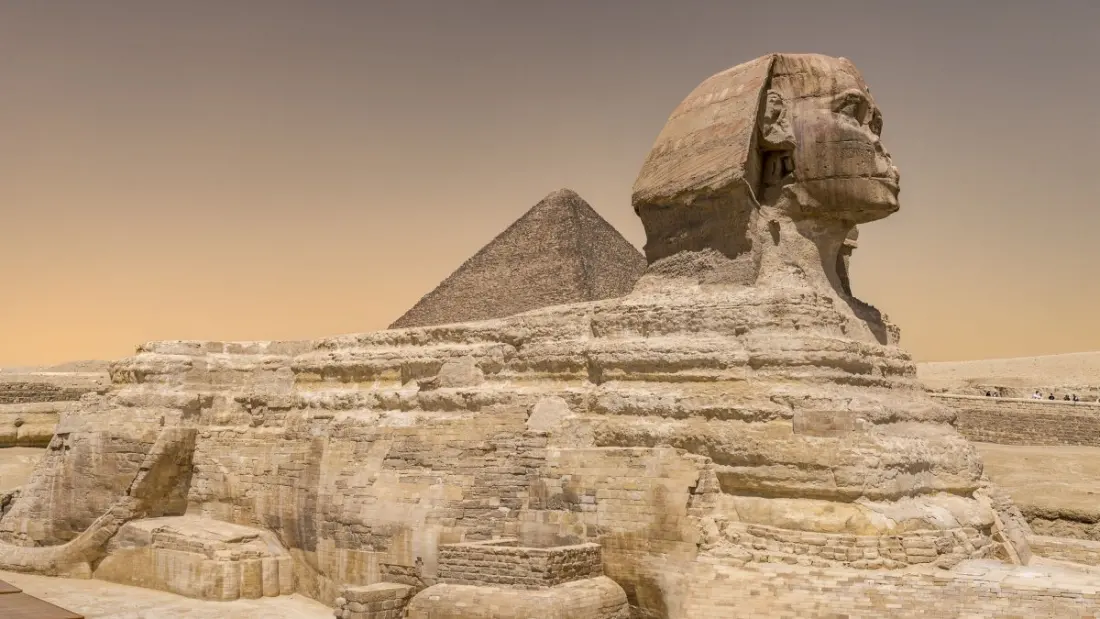
Here's a twist for anyone planning that Giza itinerary: the stone the Great Sphinx was carved from has just yielded a brand-new prehistoric species. Researchers have identified fossils from Egypt's Mokattam Formation — the same limestone deposit used to build the Sphinx and the Giza pyramids — as a distinct crocodilian that swam in a shallow tropical sea covering northern Egypt roughly 45 million years ago.
The animal has been named Herugavialis cairensis. 'Heru' is another name for the ancient Egyptian god Horus, possibly an inspiration for the Sphinx itself, while 'cairensis' nods to Cairo. The species belongs to the gharial family — crocodilians with those distinctive long, narrow snouts. Today only two gharial species survive, both endangered and both confined to South and Southeast Asia. But this find strengthens the case that gharial-like crocs once roamed the Mediterranean region for tens of millions of years, with some living in the sea rather than rivers.
The star specimen is a nearly complete skull dug up back in the 1920s, long assumed to belong to Tomistoma, the genus of the modern false gharial. Using CT scans to peer inside the skull, scientists compared more than 300 anatomical features against living and extinct crocodilians. The verdict: enough differences to earn it a whole new genus. The study appeared in Royal Society Open Science, led partly by Philip Mannion of University College London.
One detail delighted the researchers: the fossil skull is missing the tip of its snout — an accidental echo of the Sphinx's famously lost nose. As Mannion put it, that coincidence helped inspire the Horus-themed name.
The Mokattam Formation itself is worth knowing about if you're heading to Egypt. This limestone layer holds fossils of fish, sharks and early whales from when the region lay beneath the ocean, and the stone quarried from it built some of the most famous monuments on Earth. So when you stand before the Sphinx, you're looking at compressed remains of an ancient seabed — one that occasionally hands scientists a 45-million-year-old predator.
For travellers, this doesn't change your Giza plans so much as enrich them. The story adds a layer to the plateau's appeal beyond the usual pyramids-and-camel framing, and it's a good excuse to book time with a knowledgeable Egyptologist guide who can explain the geology as well as the archaeology. It also pairs nicely with a trip to Wadi Al-Hitan, the Whale Valley fossil site southwest of Cairo, where you can see early whale skeletons from the same ancient sea.
Why it matters: Egypt's monuments keep generating new science, and stories like this give visitors fresh angles on a destination many think they already know. Ancient stonework, a missing nose and a long-snouted marine croc — the Sphinx's story just got a few million years longer.
Reported by Daily Sabah Travel.