
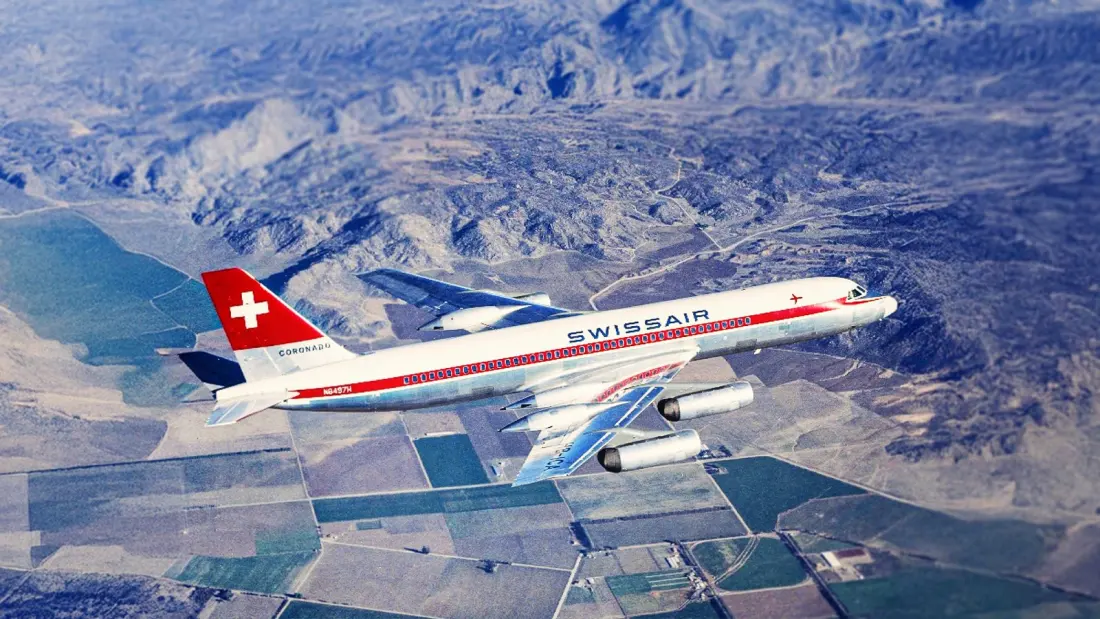
Before Concorde, the fastest subsonic airliner in the sky was an American oddity: the Convair 990 Coronado, a four-engined jet built by General Dynamics between 1961 and 1963. It cruised 25-35 mph quicker than the Boeing 707 and Douglas DC-8 it competed against, and at its heart sat one of the strangest engines ever fitted to an airliner — General Electric's CJ805-23, a turbofan with its fan mounted at the back.
The idea looked clever on paper. GE's military J79 turbojet had a single-spool compressor spinning too fast to drive a large front fan, so instead of redesigning the whole engine the way Pratt & Whitney did with its two-spool JT3D, GE simply bolted a fan behind the turbojet. The result was the first turbofan in the world to enter airline service, delivering 40% more takeoff thrust, 15% better fuel burn than the base engine, and quieter takeoffs. But it vibrated in certain regimes, demanded heavy maintenance, burned more fuel than the rival JT3D, and trailed a distinctly smoky exhaust. Convair had designed the 990 around it, so there was no swapping in the better engine later.
The bigger problem was strategy. Convair bet on speed while airlines were buying economics. The 880 (65 built) and 990 (37 built) carried fewer passengers than a 707 or DC-8 while arriving only marginally earlier. Both arrived late to a market the 707 and DC-8 had already locked up, and the 990 initially missed its own speed promise — extra drag capped it near Mach 0.84 until redesigns restored the planned Mach 0.89 cruise, by which point American Airlines had slashed its order. The 1970s oil shocks then finished off fuel-thirsty designs everywhere.
The financial aftermath splits into two opposite stories. General Dynamics lost around $425 million in 1960s dollars — including a record $143 million in 1961 alone — and never built a commercial airliner independently again, eventually recovering through military work like the F-16. GE, despite losing roughly $80 million, treated the episode as a tuition payment. Lessons from the aft-fan program fed into the CF6, which became the world's most successful widebody engine and cemented GE's position; today GE Aerospace leads the entire aero-engine market.
For aviation enthusiasts, the Convair story is a sharp reminder that the specs we love — cruise speed, unusual engineering — don't decide which aircraft survive. Airlines chose the boring economics of the 707 and DC-8, and the fastest airliner of its day became a footnote, though a handful of Convairs and their distinctive engine nacelles survive in museums and preserved airframes for anyone curious to see this dead-end of jet history up close.