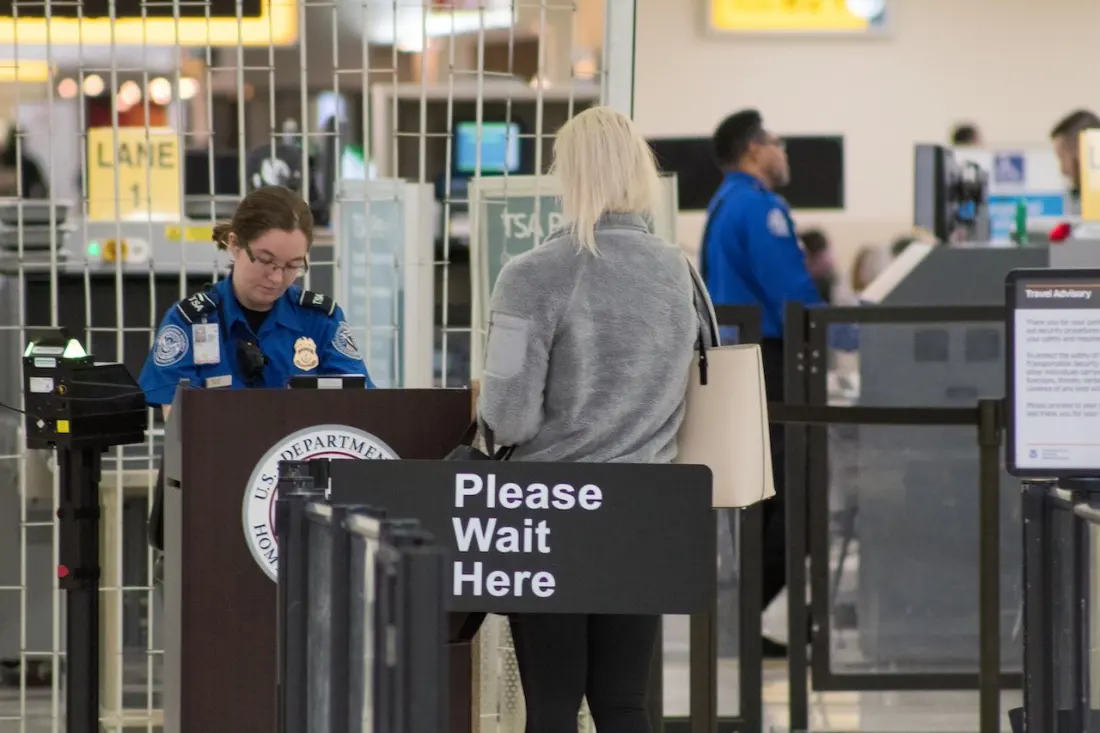
America's airport checkpoints are in the middle of their biggest shake-up since the TSA was created after 9/11. A multi-million-dollar overhaul called the Horizon 25 Strategy, announced in August 2026, aims to rebuild screening around automation, biometrics and leaner staffing — with visible changes for anyone flying in the US before 2028.
The headline numbers are stark. President Trump has proposed cutting the TSA's 60,000-strong workforce by 9,400 and trimming about $1.5 billion — roughly 20% — from its annual budget. Many see this as a runway towards re-privatised screening, a model already in place at around 20 airports including Kansas City, San Francisco and Sarasota. Unions are unhappy: officers have faced unpaid stretches during budget standoffs, and the removal of chairs at ID checkpoints has drawn criticism from the AFGE over basic working conditions. All this against rising volumes — some 900 million passengers and two billion bags a year.
Technology is the other half of the story. Around 1,162 CT scanners producing 3D baggage images now operate across 296 airports, a five-year investment experts estimate at $500-700 million. Roughly 1,200 body-scanning Advanced Imaging units cover nearly 400 airports, and CAT-2 credential authentication with facial comparison is live at about 350. Real-world friction is being smoothed too: ConfirmID, launched in February 2026, gives a verification path for travellers who show up without a REAL ID-compliant licence rather than turning them away. United Airlines and the TSA have also rolled out opt-in biometric face scans at Newark as an alternative to manual ID checks.
There are genuinely passenger-friendly perks in the mix. Gateside Visitor Access, at 13 airports, lets friends and family accompany travellers to the gate — a small luxury that vanished after 2001. A "Serve with Honor" scheme gives military communities expedited PreCheck-style lanes near major installations, and it's proving popular. The counterpoint: watchdogs note the administration has loosened pressure on airlines over service standards and compensation, so faster security may come with weaker consumer protections.
For anyone booking a US trip, the practical takeaways are real. Get a REAL ID-compliant licence before you fly — domestic flights increasingly require it, and ConfirmID is a fallback, not a guarantee of speed. Opt into biometric lanes if you're comfortable; they're often the fastest route through. PreCheck remains worth the fee if you fly domestically more than once or twice a year. And build in buffer time at big hub airports, where staffing cuts and privatisation transitions could cause short-term wobble even if the long-term promise is shorter queues. If Horizon 25 works, the checkpoint of 2028 should feel quicker and less fussy — the open question is whether that comes at the cost of worker welfare and passenger rights.
Travel Tomorrow