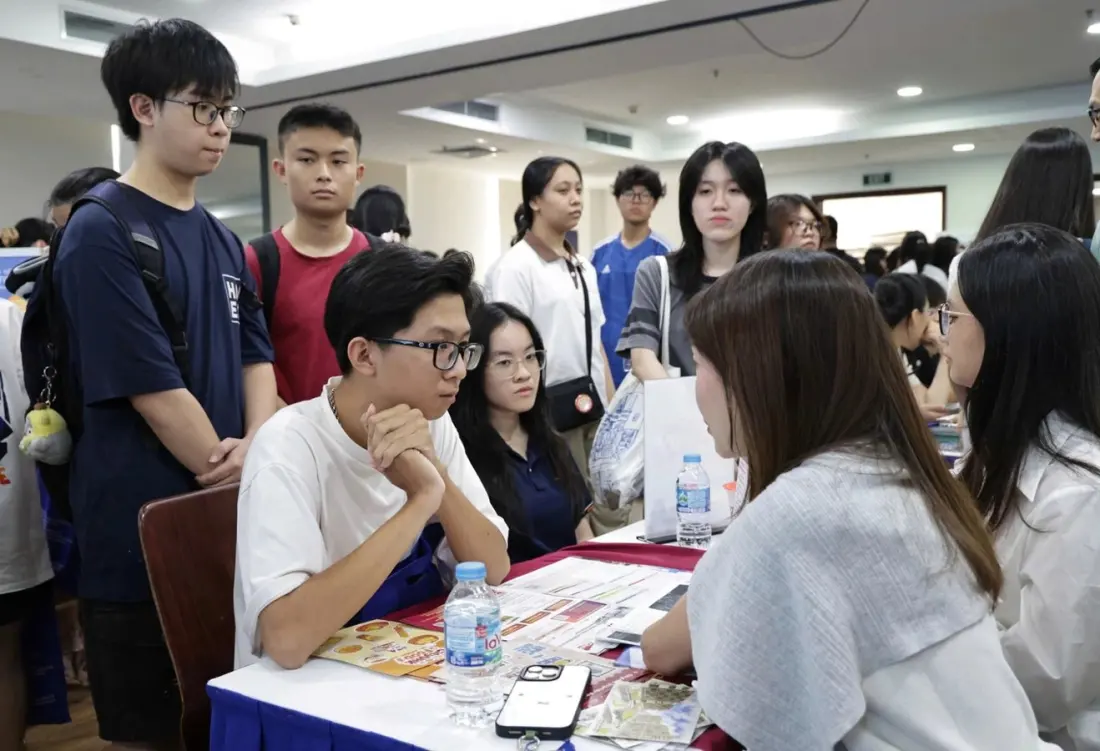
The US is losing ground with Vietnamese families planning university abroad. At a study abroad fair in Hanoi in early October, counsellors reported that 30% to 40% of their students now consider Asian universities alongside — or instead of — American ones. The clearest proof point: the University of Hong Kong received a single Vietnamese application in 2022, then 30 in 2024, and 300 this year, admitting 192 of them.
Money is the main driver. Out-of-state tuition and fees at ranked US public colleges average $26,034 a year, and $46,973 at private universities, before living costs — figures that have roughly doubled since 2007-08. Families able to budget around $11,500 to $15,400 annually, like that of a Hanoi maths student quoted at the seminar, increasingly struggle to justify the outlay.
Visa politics compound the maths. August guidance from the US Student and Exchange Visitor Program narrows curricular practical training, the standard route to internships, to programmes where training is mandatory for everyone. The H-1B lottery has shifted to a wage-weighted system favouring the highest earners, and a $100,000 fee on new H-1B petitions filed from abroad — introduced in September 2025, though later blocked by a federal court — has left families unsure whether US employers will even hire international graduates.
Meanwhile the alternatives stack up well. In the QS World University Rankings 2027, the National University of Singapore sits 10th globally, Hong Kong University 11th, and Nanyang Technological University 12th — all English-speaking, all a short flight from Vietnam. HKU charges non-local undergraduates HK$250,000 to HK$280,000 (about $31,900 to $35,700) a year from 2027-28, and reports its 2025 bachelor's graduates earning an average HK$33,338 (roughly $4,250) a month. Graduates can also stay in Hong Kong for two years without a job offer.
Admissions are simpler too. Several Singapore institutions ask mainly for a GPA of 7.0/10 and IELTS 6.0, skipping the essays and extracurricular portfolios US colleges expect. HKU has cut its minimum GPA for Vietnamese applicants from 8.0 to 7.0 and set up school-nominated scholarships with eight Vietnamese high schools, including Hanoi Amsterdam, Chu Van An and Nguyen Sieu in Hanoi and Le Hong Phong in Ho Chi Minh City.
Counsellors' advice: look past brand rankings. Research the field and career path first, and sharpen English either way. For travellers, it's a telling snapshot of how Asia's top university cities are quietly becoming the smarter, closer bet for Southeast Asian families — a trend any visitor to Singapore or Hong Kong's campuses will notice.
Original source: Vietnam Insider