
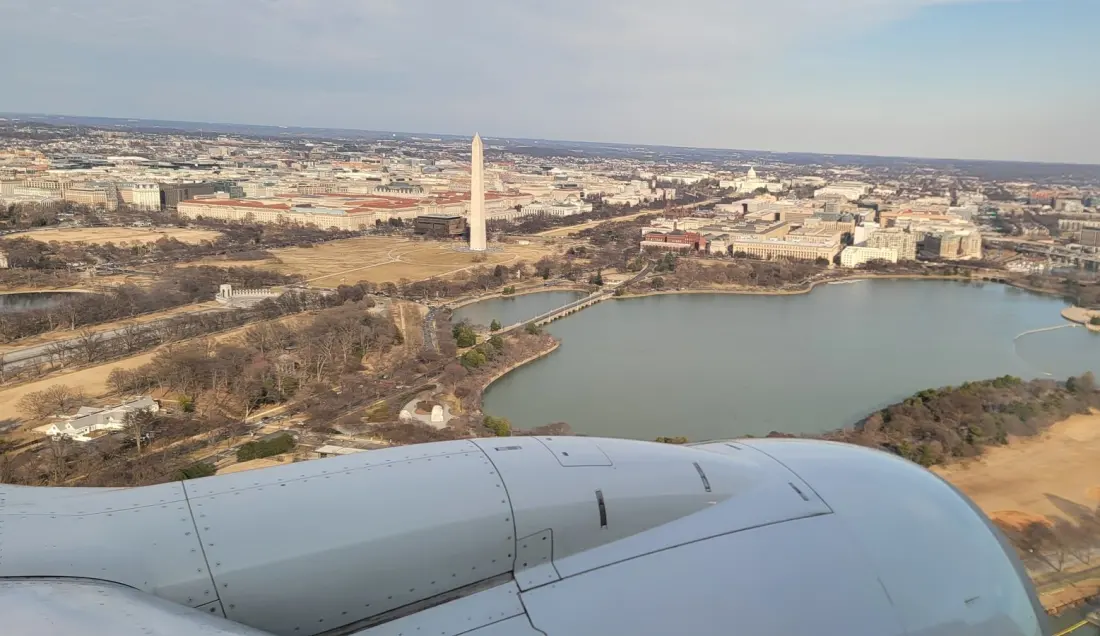
A bill from Virginia senators Tim Kaine and Mark Warner — the DCA Air Safety Act — would permanently strip 30 daily flight slots from Washington's Reagan National Airport, with at least 26 of them coming from the airport's long-haul 'beyond perimeter' flights. Those are the routes that exceed National's 1,250-mile limit and exist only through exemptions granted by the Department of Transportation. If the bill passes, the cuts must all be completed by the end of 2032, even if the FAA concludes that removing a specific flight would deliver no safety benefit at all.
The bill also caps arrivals at 28 per hour and imposes binding half-hour flight caps within 180 days of enactment. A proposal list would be due within 180 days, followed by a 60-day comment period, and judicial review of the FAA's elimination decisions would be barred outright.
Here's the part that stings for travellers: the cuts fall almost entirely on a small slice of the airport. Beyond-perimeter rights make up just 5.6% of National's slots, yet they'd absorb at least 86.7% of the eliminations. Every Alaska Airlines and Frontier route at National sits in the targeted category — the bill could wipe Alaska out of the airport entirely and remove ultra-low-cost Frontier, despite both carriers holding only about 2% of slots overall. American, Delta, Southwest, United and JetBlue hold the rest of the long-haul exemptions and would presumably reshuffle their own allocations.
Critics see a familiar pattern here. United has long opposed longer flights from National because they compete with its Dulles hub — its own employee newsletter said as much back in 2016, when it fought off a perimeter expansion. In the 2024 FAA reauthorization, United again pushed back on beyond-perimeter access while Delta pushed for more. The airports authority, which runs both National and Dulles, even tried to charge airlines $1 million a year for each new long-haul authorisation, with proceeds going to Dulles.
The safety framing is drawn from the January 2025 American Airlines 5342 collision with an Army helicopter over the Potomac, which killed everyone aboard. But the NTSB's findings point to helicopter routes crossing arrival paths, visual separation reliance, controller staffing decisions and spacing breakdowns — not flight distance. The Wichita flight involved in the crash came from inside the perimeter. The FAA has already cut the hourly arrival rate from 36 before the accident to 30 today, and runways elsewhere, like LAX's busiest, handle comparable traffic without anyone proposing to ban cross-country flying there.
For anyone flying through the Washington area, the practical takeaway is that the cheapest and some of the most convenient nonstop options at National — particularly West Coast and Mountain West routes on Alaska and Frontier — could disappear over the next several years, pushing that traffic to Dulles or Baltimore. If you're planning a future trip on a long National nonstop, keep an eye on the slot-elimination list once the FAA publishes it, because your route may be on it. And if you care about how slot politics shape which cities you can fly to directly, this bill is a textbook case of safety arguments and competitive interests overlapping — with passengers holding the shortest end of the straw.