
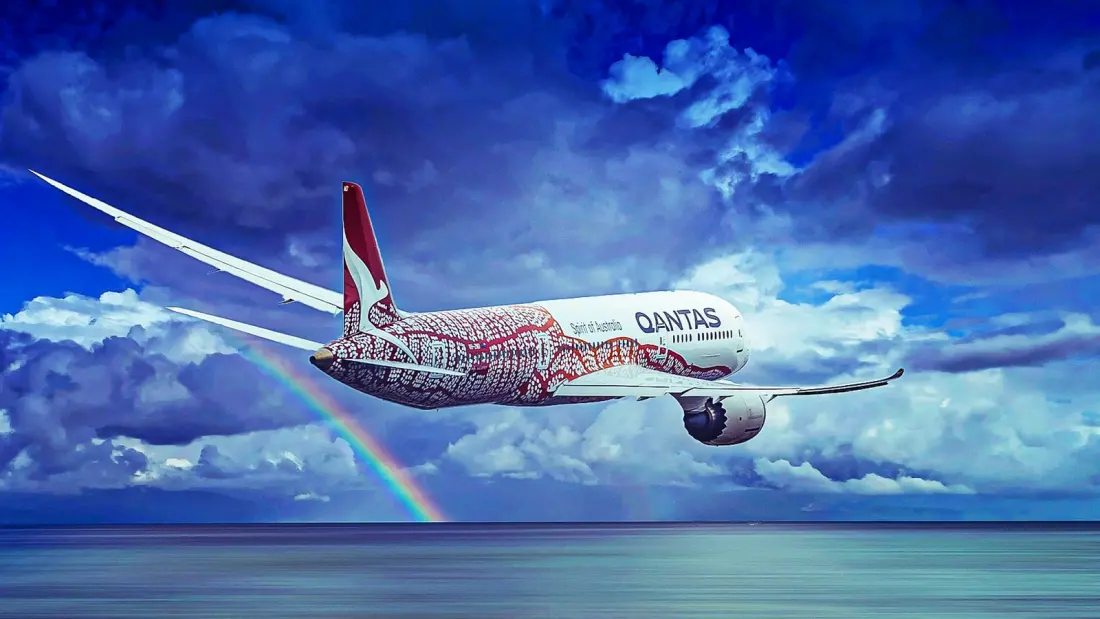
For decades, flying from Australia to anywhere beyond Asia meant a change of planes in Singapore or Hong Kong. Qantas built its international network around those two gateways, funnelling passengers through massive hubs on high-capacity aircraft. That model is quietly being dismantled, and the Boeing 787-9 is the reason why.
The Dreamliner's range and fuel efficiency let Qantas connect Australia directly to markets that generate enough local demand to fill a mid-sized widebody on their own — no connecting traffic required. In its FY2026 results, the airline said its long-haul 787-9 routes are now producing the strongest contribution margins anywhere in its international network, along with the highest customer satisfaction of any widebody type it flies. Qantas currently operates 14 of them, with more arriving from 2027.
The clearest evidence of the shift is India. Instead of routing travellers to India through an Asian hub, Qantas flies direct from Sydney to Bengaluru, and from October 2026 it adds a seasonal Melbourne-Delhi service — a route that leans on strong business and tech demand rather than leisure alone. Japan follows a similar logic: Qantas flies daily to both Tokyo Haneda and Narita, then relies on codeshares with Jetstar Japan for onward reach to Osaka, Sapporo, Fukuoka and Okinawa. It even agreed in 2026 to sell its 33.32% stake in Jetstar Japan, keeping the flying while shedding the ownership burden.
Singapore and Hong Kong aren't being abandoned, though. Qantas still serves Hong Kong from Sydney and Melbourne, and Singapore remains its Europe corridor hub with flights from four Australian cities to London. But the signals of a leaner approach are hard to miss: Jetstar Asia, the group's Singapore-based budget carrier, shut down permanently on 31 July 2025 after rising costs and regional competition, and the A380 fleet — the backbone of the old hub model — starts retiring in 2028. By FY2031, Qantas expects roughly 70% of its seat-kilometres to fly on next-generation aircraft, including the A350-1000ULRs that will launch Project Sunrise nonstops to London and New York from 2027.
For travellers, this means more nonstop options between Australia and places that were once awkward multi-leg trips — and a good benchmark for how flexible mid-sized aircraft are reshaping long-haul networks worldwide.