
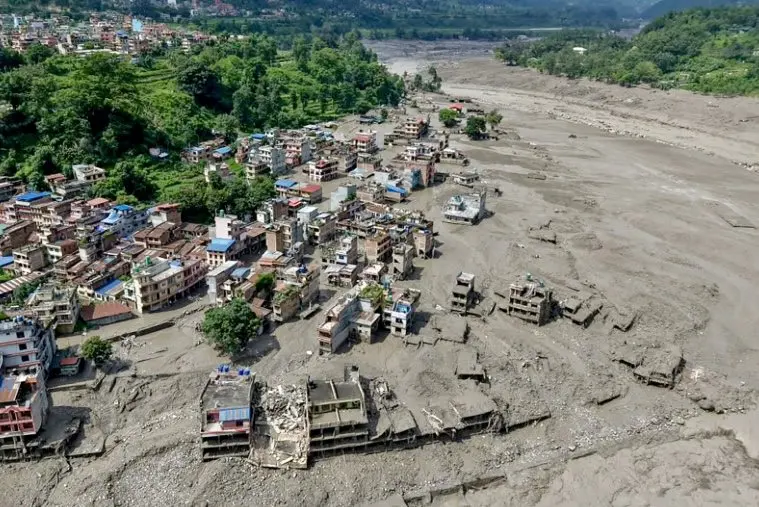
A single catastrophic landslide on Langtang Lirung has become one of the deadliest disasters in the Nepal–Tibet border region in years. Officials now count at least 1,453 people dead and 6,664 missing after the August 26 collapse sent a torrent of rock, ice and mud through the Kyirong Valley on both sides of the border. Nepal bears the heaviest toll, with 1,410 killed and 6,145 unaccounted for; neighbouring Kyirong County in Tibet reports 43 dead and 519 missing.
The mechanics are staggering. Rock and ice sheared off the north flank of the 7,227m peak from an elevation of around 5,200m, then fell more than 2,200 vertical metres. The debris flow covered 20 to 22km in roughly seven minutes, racing down the Lhende Khola toward the border. It was initially mistaken for a small earthquake, then reclassified as a landslide that itself generated a magnitude 5.2 seismic shock. Everything on the narrow valley floor in its path was destroyed: border buildings, the road to Gyirong Port, and the Rasuwagadhi crossing, one of the busiest land links between China and Nepal. Further downstream, floodwater and mud filled hydroelectric tunnels, took out bridges and flattened riverside villages along the Bhote Koshi and Trishuli.
Among the hundreds of foreign nationals missing are a mix of travellers whose routes crossed the disaster zone: pilgrims bound for Mount Kailash, traders, hydroelectric project workers and trekkers. Identification has been slow, and authorities caution the missing-person lists likely overlap with unidentified bodies already recovered. Some victims were carried as far as 240km downriver into India.
One crucial detail for trekkers: the debris flow bypassed the main Langtang trekking valley itself, tearing instead through the Kyirong–Rasuwa corridor. That distinction matters, but it is cold comfort for anyone planning overland travel between Nepal and Tibet. With the Rasuwagadhi crossing and the Gyirong road wiped out, the standard Kathmandu–Lhasa overland route via this border point is effectively severed for the foreseeable future, and rescue and relief operations continue along the Trishuli corridor, the same road corridor trekkers and overlanders typically use to reach Rasuwa and Langtang.
Anyone with trips booked in the region should treat the situation as fluid: check with trekking agencies and local authorities before committing to Langtang, Rasuwa or Kailash-bound overland itineraries, expect the casualty figures to change as counts are reconciled, and be prepared for road closures and detours well beyond the immediate disaster zone. Travellers currently in Nepal should also register with their embassy or consulate so they can be accounted for in ongoing lists, and consider flying rather than driving on any Nepal–China routing until the crossing reopens. This is a live disaster, not a closed chapter, and conditions on the ground will keep shifting through the autumn season.