
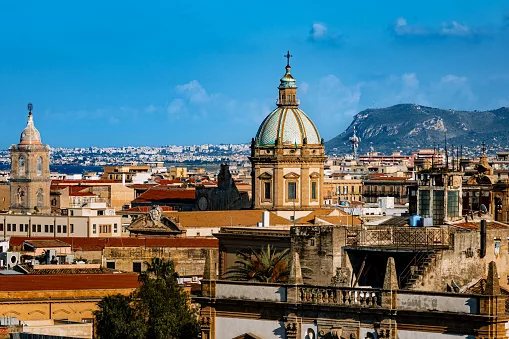
Palermo has the standard Sicily brochure stuff — sunlit churches, ornate palazzi, narrow lanes smelling of fried food — but the Sicilian capital earns a full three days because almost none of its story fits on a postcard. Arab, Norman, Byzantine, Spanish and Italian influences are stacked into a single city, enough that UNESCO lists its Arab-Norman monuments as one site: the Royal Palace and Palatine Chapel, Palermo Cathedral, San Giovanni degli Eremiti and Santa Maria dell'Ammiraglio among them.
A sensible first day starts at Ballarò, the city's oldest and largest market, in the Albergheria district. It dates back to Arab rule, and vendors still use the abbanniate — loud, rhythmic calls — to draw customers. It's the ideal place to work through Palermo's street-food canon: panelle (chickpea fritters in bread), crocchè potato croquettes, and for the brave, pani câ meusa, a spleen sandwich, or stigghiola, grilled offal skewers. From there, wander past the Baroque Church of the Gesù, then to Quattro Canti, Piazza Pretoria's 16th-century fountain and Palermo Cathedral. Finish the evening in Vucciria, where a daytime market becomes the city's noisiest nightlife zone around Piazza Caracciolo.
Day two belongs to the cultural layers. The Palatine Chapel inside the Norman Palace is the highlight — gold mosaics and geometric patterns where Western, Islamic and Byzantine traditions visibly borrowed from each other. San Giovanni degli Eremiti, with its red domes and quiet garden, makes a calmer follow-up. Take a long lunch: pasta con le sarde, caponata, seafood, then cannoli or cassata. Spend the afternoon in Kalsa, where the restored 18th-century Palazzo Butera mixes contemporary art and old masters under one roof, and the roofless church of Santa Maria dello Spasimo frames open sky with medieval stone.
The last morning is for Capo market, in the old Seralcadio district — graze on street food, fruit and pastries as breakfast. Then Teatro Massimo, one of Italy's monumental opera houses, still central to Palermo's cultural life with a packed 2026 summer programme that spilled beyond its walls into the streets. Keep the rest of the day loose; Palermo rewards unplanned wandering, whether that's a hidden Baroque courtyard or a bakery you hadn't intended to stop at. Return to Vucciria for the final evening.
Why it matters: Palermo suits travellers who want substance with their sunshine — it's affordable by Western European standards, walkable, and its food culture is arguably the most distinctive in Italy. Three days is enough to cover the UNESCO circuit and the everyday city without rushing.