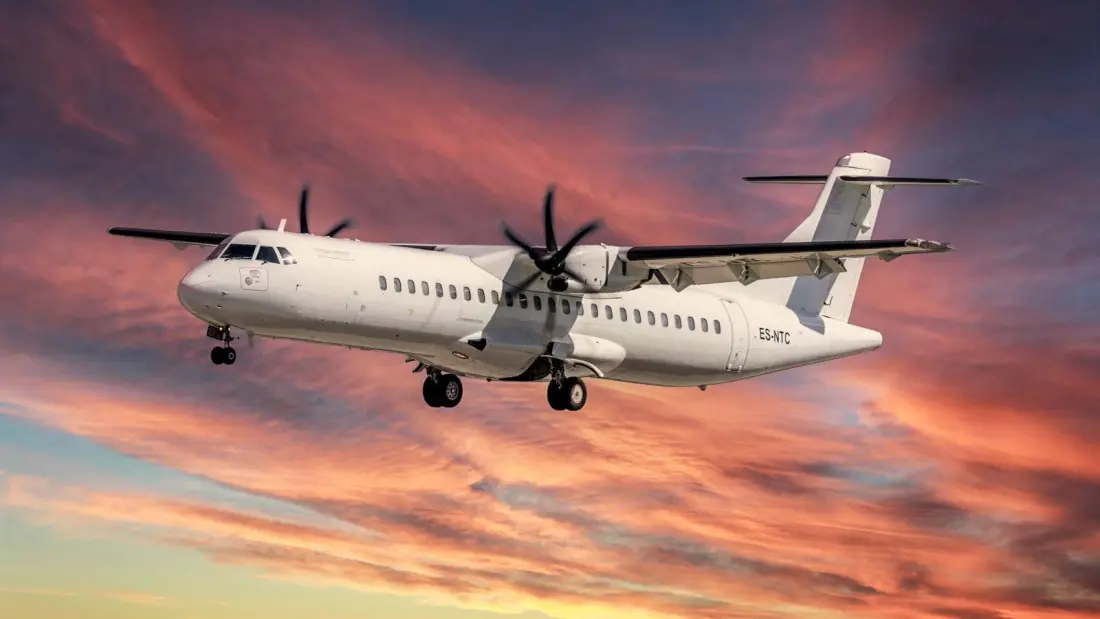
The ATR 72's two big propellers are its signature feature, and they also raise an obvious question for nervous flyers: what happens when a bird hits one? The honest answer, according to a detailed look at the certification rules, is that the blades are not a shield and the aircraft is not bird-proof. What keeps passengers safe is something more interesting — a layered system of engineering rules, inspections and airport wildlife management.
Because the propellers sit ahead of the engines, a bird usually strikes a blade before reaching any engine inlet. That changes the physics compared with a jet, but it doesn't remove the danger. A strike can damage a blade, spinner or hub and create an imbalance that forces a crew to shut an engine down. The European Union Aviation Safety Agency therefore certifies the propeller itself as a safety-critical component under rule CS-P 360, which requires testing or analysis showing the propeller can survive defined bird impacts — up to 1.8 kg — without a major or hazardous failure. The goal isn't an unscarred blade; it's damage that stays within a controlled safety envelope.
The airframe has its own protections. Under the CS-25 framework covering the ATR 72, rule CS 25.631 requires the aircraft to be designed for continued safe flight and landing after a defined bird impact, and the windscreen directly in front of the pilots must withstand those conditions without penetration. So certification looks at the whole aircraft — structure, controls, essential systems — rather than assuming the propellers absorb everything.
Turboprops and jets are simply tested differently. Turbofan engines face bird-ingestion requirements focused on what happens inside the engine, a standard shaped in part by the 2009 US Airways Flight 1549 accident, where Canada geese far larger than test birds disabled both engines of an Airbus A320 and led regulators to tighten flocking-bird rules. Asking whether an ATR 72 is more bird-resistant than a jet misses the point: they're engineered around different hazards.
Certification is only the baseline. Bird encounters cluster at takeoff and landing, exactly the phases that dominate a regional turboprop's life of short hops and frequent airport visits. Airport wildlife programmes, habitat management and pilot reporting reduce the odds of a strike; maintenance and post-strike inspections — easy on the ATR, whose blades are visible and accessible — catch damage passengers never notice. EASA also keeps issuing type-specific airworthiness directives for the ATR 72 family, so safety oversight continues long after the aircraft left the factory.
For anyone booking a regional flight on an ATR 72, the takeaway is reassuring: these aircraft aren't relying on luck or a single design trick, but on decades of layered safety requirements that assume bird strikes will happen and ensure they don't become catastrophes.