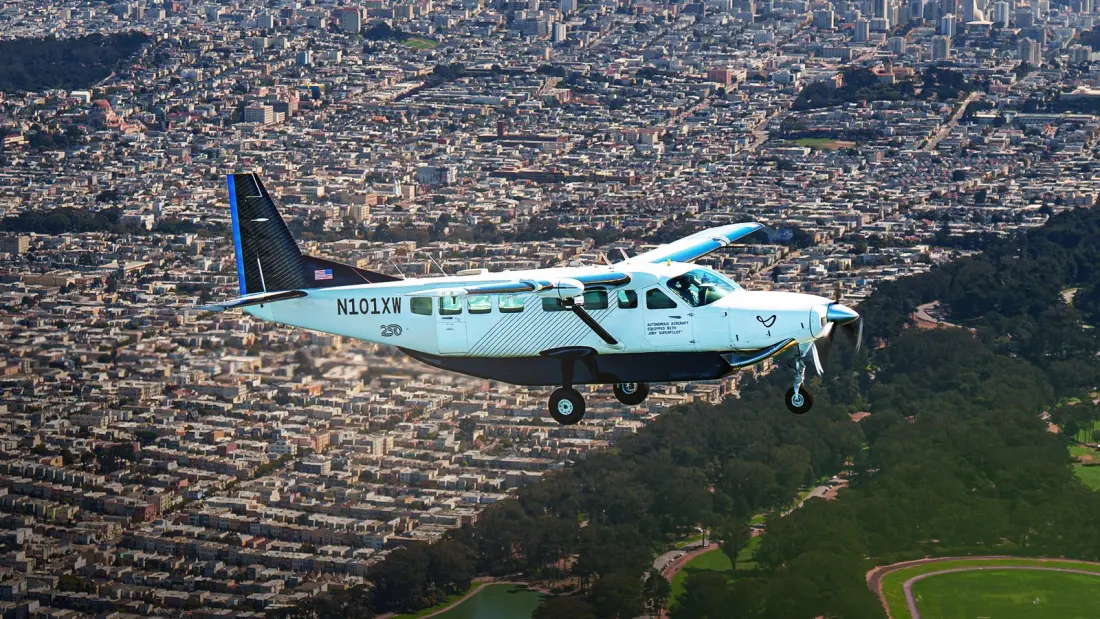
A 33-year-old Cessna 208B Grand Caravan just completed the first fully autonomous flight across the United States, and the strangest part is how unremarkable the aircraft looks. On 7 September 2026, the converted Caravan — Joby calls it the J208 — rolled off the runway at Buchanan Field in Concord, California, and for the next week it taxied, took off, navigated around thunderstorms, and landed entirely on its own. A safety pilot sat on board the whole way and made zero control inputs.
The aircraft touched down at Dare County Regional Airport in North Carolina's Outer Banks on 14 September, having covered 3,199 miles (5,148 km). Nobody was flying it from the cockpit; supervision came from ground stations at Joby's Autonomy Headquarters in California and Shaw Air Force Base in South Carolina, sometimes from as far as 2,323 miles away. The system had never operated at any of the airports on the route before, and handled them all anyway.
The routing was a deliberate test card. Phoenix Deer Valley, one of America's busiest general aviation fields, tested how the aircraft sequences itself among flight-school traffic and business jets. Fort Worth Alliance showcased the freight case. Shaw Air Force Base demonstrated military readiness — fitting, since the software's pedigree includes an Air Force Military Flight Release from 2024. Then came the symbolism: before landing, the J208 flew a low pass near the First Flight Monument at Kitty Hawk, four miles from where the Wright brothers got airborne 123 years earlier.
The backstory is a corporate plot twist. Joby is known for its piloted electric air taxis, which began demo flights over New York in April 2026. The autonomy flying this turboprop came from Xwing, whose division Joby bought in June 2024 along with the very airframe — registered N101XW, built in 1993 — that had been flying itself since 2020. Xwing's Superpilot software had already logged 250 fully autonomous flights and over 500 auto-landings before the acquisition. Using an airframe the FAA certified decades ago was the strategic point: it narrows certification down to the autonomy alone, with hundreds of existing Caravans as potential retrofit candidates.
The tour isn't over. The aircraft is now working back west with stops in Raleigh, Fredericksburg, Louisville, Wichita, Oklahoma City, Salt Lake City and Portland, adding hours and airport environments ahead of a future FAA certification case.
For travellers, this is less about tomorrow's flights and more about the direction of aviation — autonomous cargo and medical runs to remote communities first, with the technology maturing behind the scenes. Anyone tracking the return leg can follow N101XW on a live flight tracker. And if the Kitty Hawk angle has you plotting an Outer Banks trip, the Wright brothers' original patch of sand is very much worth the detour.