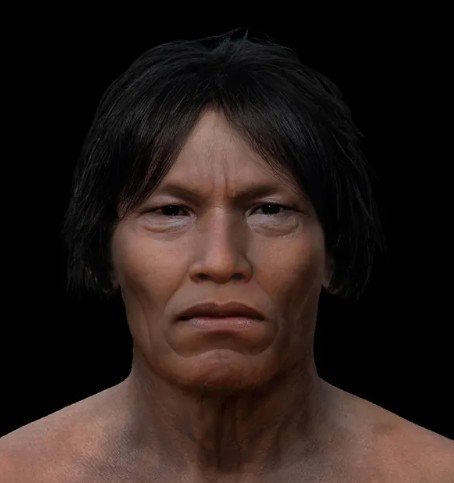
A man who lived in Ecuador's central Andes roughly 3,000 to 4,000 years ago now has a face again. Forensic craniofacial anthropologist Christopher Rynn of the University of Dundee, working with Ecuadorian sculptor Hector Flores Franco of the University of Chimborazo, has reconstructed the features of the so-called Punin-2 skull — and the result settles a century-old scientific argument.
The skull was found in the 1970s by a farmer in a ravine near the town of Punín, in Chimborazo province. It shares the ravine with a more famous predecessor, Punin-1, unearthed in 1923 during an American Museum of Natural History expedition. That earlier skull's prominent brow led scientists in 1925 to propose wild theories: that it showed Oceanic ancestry, perhaps from ancient contact with Australians or Pacific Islanders. Its sediment layer, seemingly older than modern humans, even fuelled speculation about Neanderthals or Homo erectus in South America.
The new reconstruction ends all that. Rynn says there's no doubt the man was Indigenous American — descended from the ancestral group of North Siberians and East Asians who crossed into the Americas during the last ice age. Geological studies have also clarified the timeline: erosion mixed the human remains with much older Pleistocene fossils like mastodons and giant sloths, but the man himself lived far more recently. Osteological work suggests he was a hunter-gatherer who died at around 50 years old.
Rynn deliberately avoided learning about the skull's background so his reconstruction would rest purely on its shape. Local communities still shaped the result, though. Elders advised on a hairstyle specific to Chimborazo's tribal groups — black hair, parted in the middle — and corrected early versions where the eyes sat too far forward, an East Asian trait rather than a Native American one. A physical bust with real hair is due in 2027, and the team is fundraising to reconstruct the Punin-1 skull too, plus attempts at ancient DNA analysis of both.
The digital face has already been shown to a small group of people from the Chimborazo region considered likely descendants. As Rynn put it, it's a portrait of their actual ancestor — and they seem to like it.
For travellers, this is a good reminder that Ecuador's Andean heartland offers more than the well-trodden avenúa of markets and volcanoes. Chimborazo province, home to Ecuador's highest peak, holds archaeological layers that keep rewriting the story of the Americas. The University of Chimborazo in Riobamba is involved in the ongoing project, and the region's museum scene and Indigenous communities give visitors a direct line to the cultures that have occupied these highlands for thousands of years. If you're pairing Quito with the Avenue of the Volcanoes, Chimborazo makes a natural extension — and you'll be walking the same ravines where a farmer stumbled onto history twice in one century.
Cuenca High Life