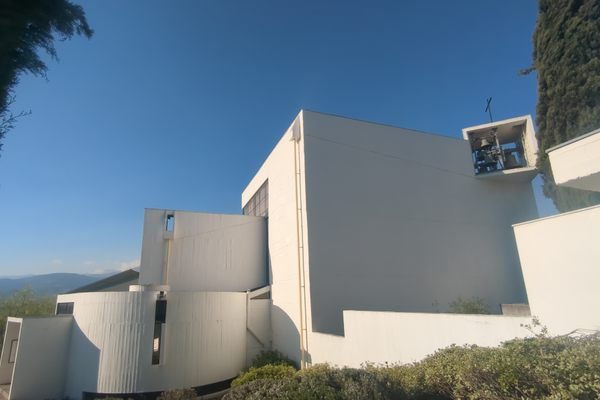
Santiago's wealthiest suburb isn't an obvious place to find monastic life, but the Benedictine Monastery of the Holy Trinity sits quietly in Las Condes, a short walk from some of the city's most expensive real estate. Built in the 1960s, it's one of South America's most striking pieces of religious modernism — and remarkably, hardly anyone outside Chile seems to know about it.
The church was designed by two of the resident monks themselves, graduates of the Valparaiso school of architecture, a movement famous in Chile for treating light as a building material. That obsession shows everywhere here. The main structure is a suspended cube, all hard angles meeting sweeping curves, and dozens of carefully placed openings let daylight move through the interior as the hours pass. Go early in the morning or late afternoon if you can — that's when the effect is at its best. By evening, the setting sun hits the Andes directly behind the building, turning the mountains themselves into part of the architecture.
The approach is part of the design too. The long main driveway climbs gently, and the Andes reveal themselves gradually as you walk, with the church appearing only at the end. It's a deliberate piece of staging that the monks built into the landscape, and it works even if you have zero interest in architecture.
Sixteen monks still live here, following the Benedictine rhythm of prayer and work. They sometimes perform Gregorian-style chants in the church during the evening, and hearing those voices inside a concrete cube while the light fades over the mountains is easily one of Santiago's most atmospheric free experiences.
For visitors, the practicalities are simple. The monastery sits on the eastern edge of the city, where Santiago runs out of suburbs and the mountains begin, and public transport from the centre takes roughly an hour. The church is open to the public; the monastery quarters generally aren't, so don't expect a full tour of monastic life. What you get instead is the building, the light, the silence, and the view.
It also makes an odd but rewarding pairing with the neighbourhood itself. Las Condes is home to some impressively designed residential architecture, so architecture fans can easily string together a half-day of modernist spotting. Travellers who usually stick to Santiago's historic centre or the artsy Bellavista district often skip this side of the city entirely — which is exactly why it stays peaceful.
Who's it for? Design lovers, anyone chasing quiet after a few days in a big city, and hikers who want a contemplative warm-up before heading into the Andes proper. There's no ticket booth, no gift shop, no queue. Just check the timing of your visit against the sun, aim for that late-afternoon window, and stay if you hear chanting starting.