
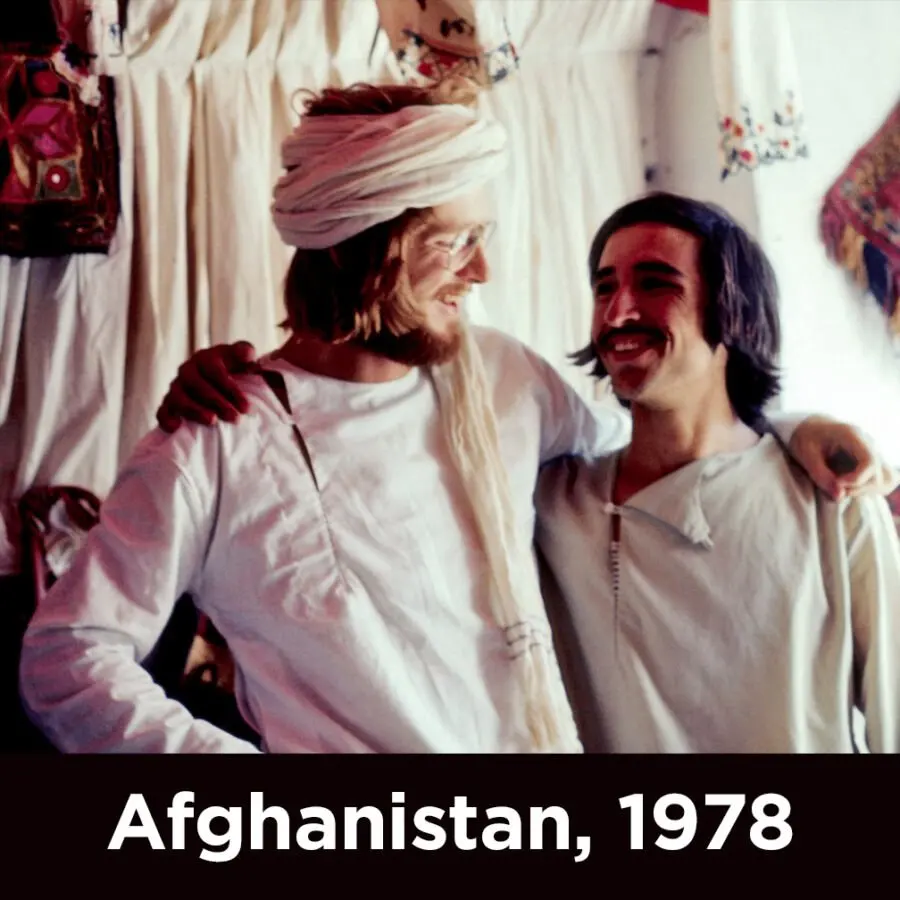
Before he became America's most familiar travel guru, Rick Steves was a 23-year-old backpacker riding the Hippie Trail from Istanbul to Kathmandu. A newly published entry from his 1978 diary, written in Herat in western Afghanistan just before the Soviet invasion, captures a country that has since vanished — and it makes for strangely gripping reading today.
The day he describes costs almost nothing by modern standards. He and his friend Gene changed $100 for 3,858 afghanis in a bank heist of an hour, negotiated under the eye of a bayonet-wielding guard. A $5 bus ticket on the Qaderi company would later carry them 800 kilometres to Kabul. Dinner — a plate of vegetables and meat plus endless tea — came to $1.50 each, and a small bed-and-breakfast of fried eggs, yoghurt and black chai started the morning.
But the money is the least of it. The journal is really a portrait of daily Herat life: horse-drawn taxis on dusty side streets, men at hand looms weaving cloth, fruit stalls, old women in full cover asking to be photographed, and a bazaar where Steves haggled hard — 600 afghanis down to 40 each for embroidered pouches, a near-miss on white baggy local dress at a ceiling of 152. The famous Herat mosque gets a visit, as does a wedding at the hotel, where the bride's father shook the foreigners' hands and the band played late.
It's also candid about the era's Hippie Trail habits. Steves writes about trying hashish — legal-adjacent and woven into local social life then — bought for the equivalent of a dollar, and about feeling like an outsider among people who 'work so hard and live so simply'. That self-awareness, unusual in a backpacker's diary, is part of what makes the entry worth your time.
Why read it now? Because it documents a Herat that no traveller can visit today: open overland routes across Asia, a city welcoming curious Westerners, a nightlife of torch-lit chariots and street soup. For anyone interested in how travel writing ages — or in Afghanistan before four decades of war — it's a rare first-person time capsule, and it's part of a five-part series on his blog.