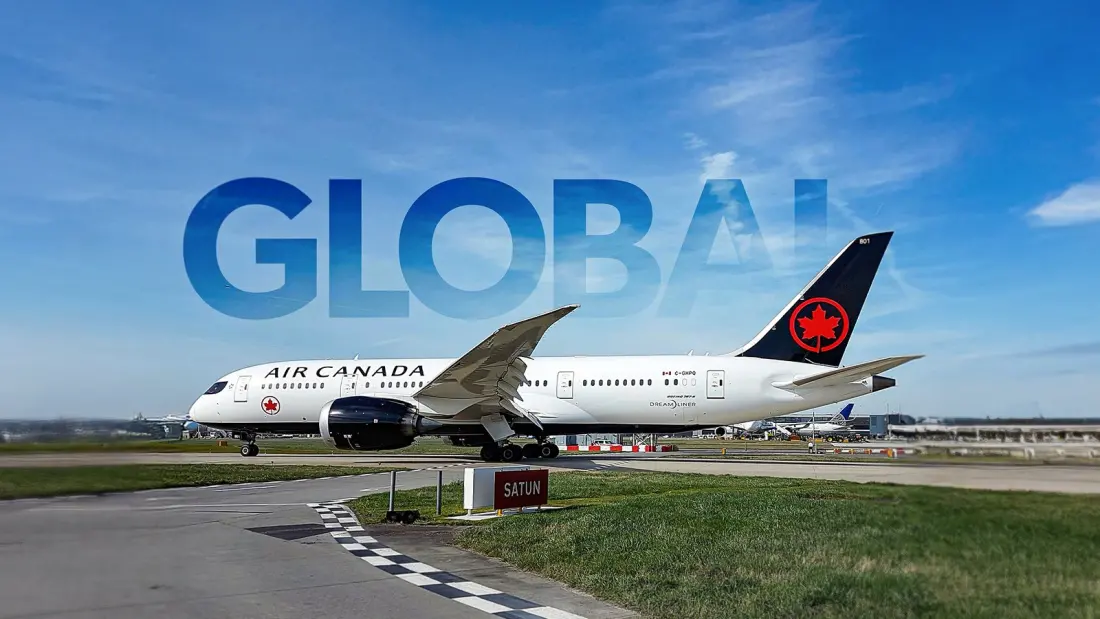
Canadians are flying south far less than they used to. Return air trips from the US were down 27% in July 2026 versus two years earlier, and Air Canada's own Canada–US flying shrank 13% over the same period. Rather than shrink, the airline is rebuilding its whole network around the rest of the world.
The centrepiece is a Summer 2027 schedule with more than 125 international routes to over 85 non-US destinations and up to 169,000 international seats a week — an 8% capacity jump on Summer 2026. Five new cities appear on the map: Guangzhou, Oslo, Shannon, Basel and Dubrovnik.
The logic is geography. Toronto, Montreal and Vancouver are being repositioned as transfer points, not just gateways to Canada. Under a sixth-freedom model, Air Canada profits from passengers who merely connect through its hubs — Toronto linking the US and Europe, Montreal feeding the Atlantic, Vancouver bridging North America and Asia. Guangzhou, launching from Vancouver on 4 May 2027 three times weekly on a Boeing 787, makes Air Canada the only North American carrier flying to that city nonstop, routed around closed Russian airspace. Canada–China capacity is already up sharply, with Air Canada's share of it rising to about 37%, and Toronto–Shanghai going daily.
Europe gets a different tool. The Airbus A321XLR, with 14 lie-flat Signature seats and 168 economy seats, lets Air Canada serve thinner markets a widebody can't fill: Toronto–Oslo four times weekly, Toronto–Shannon three, Montreal–Basel four. Meanwhile the 787 handles Asia and thicker European routes, Montreal–Dubrovnik among them, and an A330 covers Toronto–Nice twice weekly. The first of 14 Boeing 787-10s is expected in service in 2027 after production delays.
Why should a traveller care? If you live in North America, connecting through Canada is about to get easier for reaching mid-size European cities and southern China nonstop — often with premium cabins on aircraft small enough to keep fares competitive. And for Canadians, the message is clear: your flag carrier is hedging against the US market by making the world, not Washington, its priority.
Whether the numbers work — enough connecting traffic to fill all those seats — is the open question. But the Summer 2027 schedule is one of the boldest network pivots any North American airline has attempted in years.