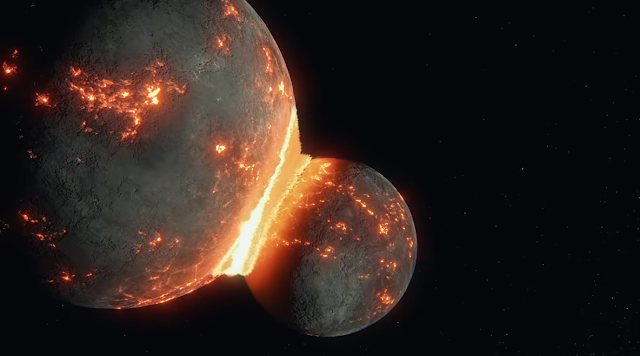
Back in the 1980s, a group of astronomers found themselves with an unusually pleasant work assignment: a scientific conference in Hawaii, convened specifically to settle a long-running argument about how the Moon came to exist. Given the islands' obvious appeal as a destination, attendance requests reportedly poured in — science, it turns out, is easier to sell when the venue has beaches.
It was at this Hawaii meeting that the giant impact hypothesis finally won over the scientific community. The idea, developed in the 1970s by astronomer William Hartmann and his colleague Don Davis, proposes that the Moon was born from debris flung into orbit after a Mars-sized planet slammed into the early Earth. Rather than the Moon forming alongside our planet or being captured wholesale, it coalesced from the wreckage of a cataclysmic collision — a explanation that gradually gained acceptance and became the leading theory.
Hartmann and Davis themselves look back on that pivotal conference, reminiscing about how the consensus formed and walking through the leading explanations for one aspect of the Moon that still puzzles scientists — a remaining mystery the pair unpack in their discussion.
For travellers, the Hawaii connection is more than a fun aside. The islands' combination of clear skies, volcanic terrain and serious scientific infrastructure has long made them a magnet for astronomers — you can visit observatory facilities on Mauna Kea on the Big Island, where some of the world's most powerful telescopes sit above the clouds. And if the story of a fateful scientific gathering nudges you towards a Hawaiian holiday, the timing works: the islands are as appealing now as they were when a queue of astronomers tried to justify the trip in the 1980s.