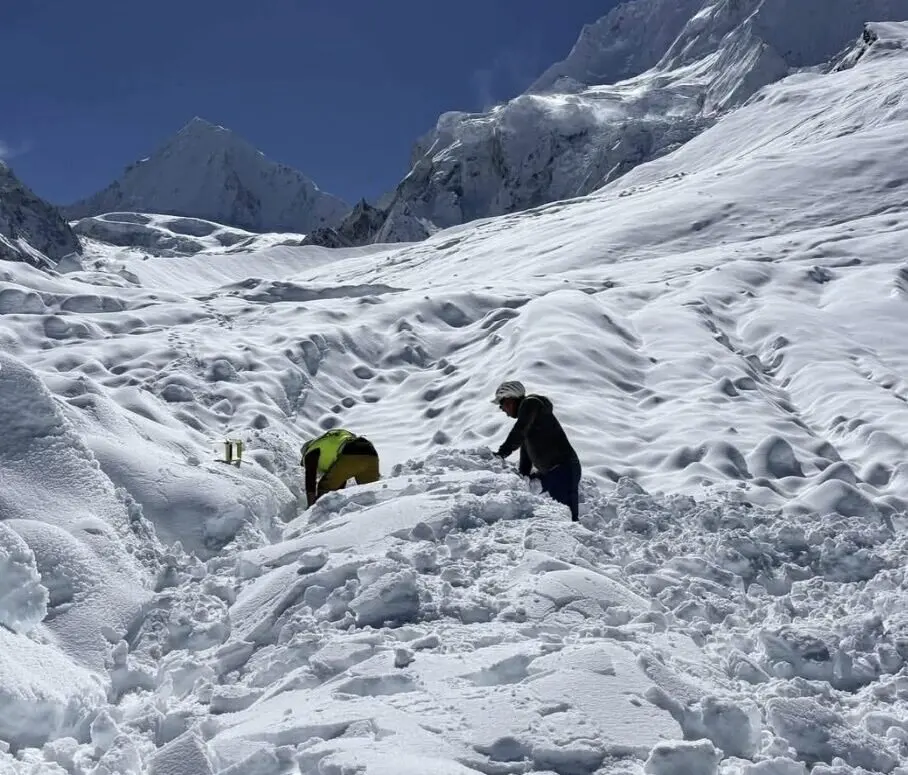
An avalanche has completely buried Base Camp on Himlung Himal in Nepal, and rescue teams have so far recovered four bodies from the site. Sixteen people — 14 kitchen staff and two climbing guides working for different companies — were in camp when the slide hit after heavy snowfall.
The Nepal National Mountain Guide Association confirmed the identities of two of the deceased as guides Chhebi Bhote and Pasang Bhote, while kitchen staff members Birendra Gurung and Ghan Shyam Rai were also among the recovered. The remaining twelve people are still missing, and hopes of finding survivors are fading fast.
Weather on the mountain had been brutal in the days before the incident, but skies finally cleared enough on Tuesday for a rescue helicopter to reach the area that evening. Wednesday saw reinforcements arrive, with an eight-member team led by Mingma Gyalgen Sherpa of Imagine Nepal. Among the rescuers are several IFMGA-certified guides, including Pasang Kaji Sherpa, Pimba Tenzing Bhote, Ashish Gurung, Tsering Pemba Sherpa, Bikram Karki, Dandu Sherpa, and Pasang Rinzi Sherpa. The loss is a bitter blow for Mingma G, who also lost staff members in the Broad Peak tragedy in late July.
Video from the site shows more than two metres of snow covering the flat plateau where Base Camp once stood. What makes the incident particularly alarming is that the location is not considered especially avalanche-prone. The mountain guide association points to a gentle slope above camp — Polish mapper Gorskie Mapie has charted the area — and believes a slide avalanche occurred, with fresh snow shearing off over frozen ground. When snowpack sits on an icy base, even a modest incline can release the entire layer above it.
For anyone considering a Himalayan trekking peak or expedition this season, the message is sobering: even the 'safe' flat ground of a base camp can be swamped when extreme snowfall meets the wrong conditions. The questions being asked now — why it happened, and how it could have been prevented — will matter to every operator and climber heading into the Nepal autumn season.
The tragedy also underlines the human cost that rarely makes headlines. Those buried were overwhelmingly kitchen and support staff, the Nepali workers who make high-altitude expeditions possible and who often spend more nights on the mountain than the clients they serve. Coverage of how the mountaineering industry protects its workforce — from weather forecasting and camp placement to evacuation plans — is likely to intensify in the wake of this disaster.