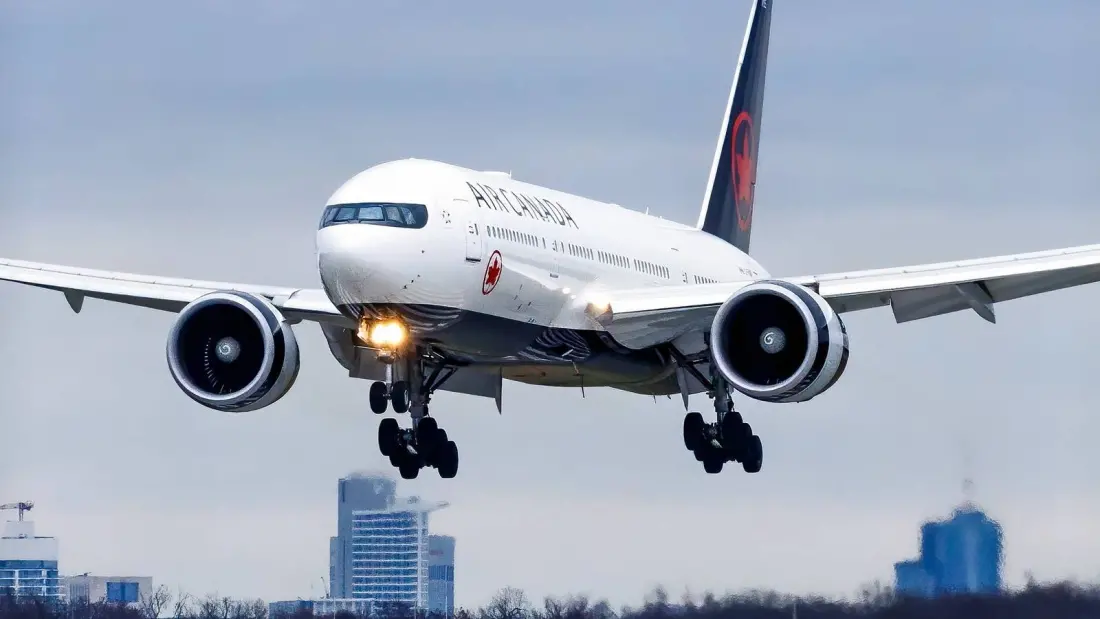
Air Canada switches to its winter timetable on October 25, and the numbers behind it are striking. Cirium Diio schedule data shows the airline planning around 47 long-haul departures a day this winter, up 10% on last year, and now carrying roughly 40% of all of Canada's long-haul flying. Most of it funnels through Toronto Pearson, Montréal-Trudeau and Vancouver.
The single longest block time on the network belongs to a one-stop routing: Toronto to Sydney via Vancouver, at 22 hours and 55 minutes gate-to-gate on a daily Boeing 777-200LR. If you prefer your hours in one uninterrupted stretch, the longest nonstop is Vancouver to Singapore, timed at up to 17 hours (usually 16 hours 45 minutes) on a five-weekly 787-9. But note the catch: Air Canada's final departure to Singapore is scheduled for January 24, 2027, so the route has a hard end date. After that, the Delhi-Toronto return leg — currently 16 hours 25 minutes thanks to headwinds and the closure of Russian and Iranian airspace — becomes the airline's longest nonstop.
The rest of the top-11 longest routes is a tour of Asia and the southern hemisphere: Vancouver to Bangkok (up to daily, 16h15), Delhi back to Montréal (four weekly, 16h10), Toronto to Buenos Aires via São Paulo (five weekly 787-9, 16h05 once), Toronto to Shanghai Pudong (four weekly, 16h00), Vancouver to Sydney (up to 10 weekly, 15h55), Toronto to Seoul Incheon (five weekly, 15h15) and Vancouver to Brisbane (daily, 15h00).
Singapore is an interesting story in itself. Air Canada first served the city until 1991, and only returned in April 2024 after Singapore Airlines pulled out of the route in September 2023. The two Star Alliance partners codeshare, which explains why more than 30% of passengers on the Vancouver-Singapore flight are connecting to another service at Changi — much of it onward across Southeast Asia and Australia.
There's also a Dubai-shaped question mark. Air Canada was due to resume Toronto-Dubai flights on October 24, but the restart has been pushed back to January 15, 2027 at the earliest, with further slippage possible given the situation around Iran. The route exists largely because of the Emirates partnership: with limited traffic rights, nearly two-thirds of Air Canada's Dubai passengers transfer onto Emirates services, mostly heading to or from South Asia. That makes the route valuable even though it wouldn't stand up on local traffic alone.
For travellers, the takeaway is simple: this is the most extensive long-haul winter Air Canada has ever run, and the last chance to fly nonstop from Vancouver to Singapore before the route ends in late January. Book early if that one's on your list, and expect eastbound India and Middle East flights to feel longer than the outbound legs — closed airspace over Russia and Iran adds real hours.